
ROOTS & DUST
Across the Valley and its foothills, there are places that no longer command the attention they once did.
A weathered schoolhouse set back from the road. An old brick storefront with windows darkened by time. A cemetery near the edge of a field. A historic marker beside a quiet highway. A main street that may no longer bustle, but still carries the memory of the people who passed through it, built around it, and called it home.
These are the smaller towns and crossroads communities of the Valley.
Some were ferry points. Some were grain depots. Some were stage stops, mining supply centers, agricultural service towns, or foothill settlements tied to older routes of trade and travel. They had stores, churches, schools, boarding houses, post offices, warehouses, and gathering places. They gave people a reason to stop, trade, worship, work, settle, and belong.
Today, some of these places are quieter than they once were. Some have been bypassed by highways, overshadowed by larger cities, or folded into the broader geography of modern life. Others remain as historic districts, rural communities, scenic stops, or names that still mean something to the families and residents who know their stories.
But quieter does not mean unimportant.
The smaller towns of the Valley remain part of the region’s fabric. They remind us that the Valley was not built only by its largest cities, major highways, and expanding suburbs. It was also built by modest communities that served farmers, miners, merchants, travelers, immigrants, ranching families, and working people who needed local places to gather and endure.
Their importance is not measured only by population or economic output. It is found in memory, identity, landscape, architecture, family history, and the continuity they provide between the Valley’s past and present.
To understand the Valley fully, we have to understand these places too.
When Small Places Were Essential
In the nineteenth and early twentieth centuries, the Valley and its nearby foothills were far more locally organized than they are today. Travel was slower. Roads were rougher. Markets were more fragmented. A community did not need to be large to matter. It needed only enough people and enough purpose to justify a store, a blacksmith, a school, a church, a warehouse, or a post office.
A ferry crossing could create a settlement. So could a rail siding, a stage route, a grain warehouse, a mining supply road, or a cluster of farms needing a common center.
In a landscape not yet tied together by highways, refrigeration, centralized processing, and large retail centers, small towns were not marginal. They were essential.
They were where people collected mail, bought supplies, exchanged news, sent children to school, repaired equipment, worshiped, voted, traded crops, and built local identity. Their scale may have been modest, but their role was real.
That is why the older map of the Valley looks so different from the modern one. There were more little centers of life, more crossroads, more local gathering places, more communities serving narrow but meaningful circles of settlement.
Many of those places never became large cities. But they helped make larger growth possible.
A Network of Memory
As transportation improved, agriculture changed, schools consolidated, and commerce moved toward larger centers, many small towns lost some of the practical advantages that had once sustained them. A depot mattered less. A local store faced harder competition. A school district merged. A post office closed or moved. A main street that once served as a destination became a pass-through.
But this should not be read only as decline.
It is also a story of adaptation.
Some communities survived by becoming heritage destinations. Some remained rural residential communities. Some became quiet agricultural settlements. Some preserved cemeteries, churches, meeting halls, schoolhouses, bridges, or annual traditions that continue to hold people together.
Others live through family names, local museums, historical societies, ranch roads, old photographs, and stories told across generations.
The Valley’s smaller towns are part of a network of memory. They hold evidence of how people lived before the region became so concentrated around larger cities and corridors. They show a Valley of more local centers, more intimate economies, and more varied forms of community life.
They are not simply places left behind.
They are places that still help explain where the Valley came from.
Knights Ferry: A Town That Became a Landmark
Knights Ferry in Stanislaus County offers one of the clearest examples.
Originally a ferry crossing on the Stanislaus River during the Gold Rush era, Knights Ferry became a busy supply town with hotels, mills, stores, and commercial importance far beyond its current size. It served movement. It served trade. It served an older geography in which river crossings and early roads mattered enormously.
Over time, larger transportation systems emerged, commerce concentrated elsewhere, and Knights Ferry’s old economic role changed. But the town did not disappear.
It became something different.
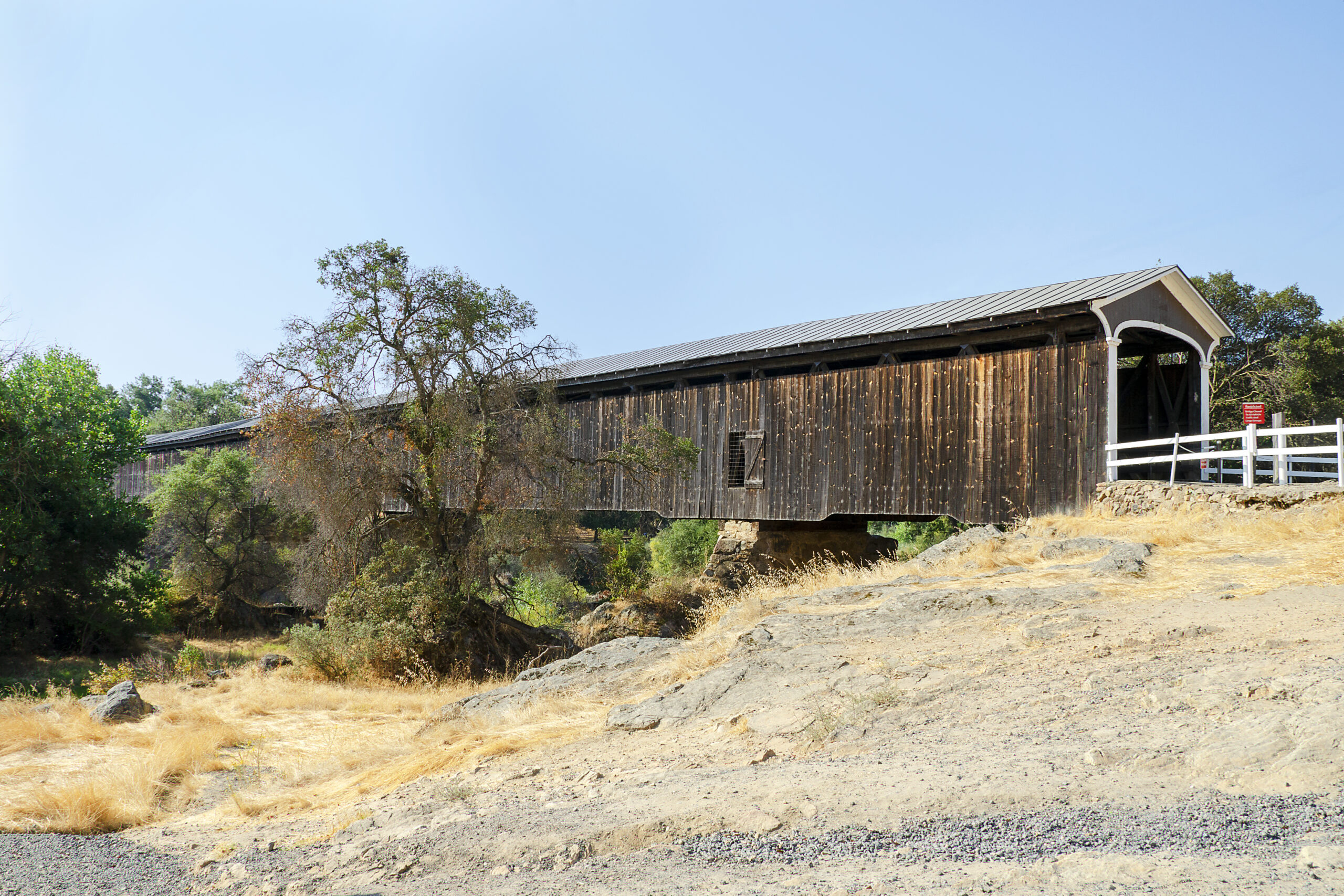
Today, Knights Ferry endures as a historic district, scenic destination, and one of the most recognizable heritage places in the region. Its covered bridge, river setting, old buildings, and preserved atmosphere give residents and visitors a direct connection to an earlier California.
Its value is no longer measured by the number of wagons, miners, farmers, or merchants passing through. Its value is found in what it preserves.
Knights Ferry reminds us that a town can lose one kind of importance and gain another.
It may no longer drive the regional economy, but it anchors regional memory.
La Grange and Civic Heritage
La Grange tells a related story.
In the 1850s through the 1870s, La Grange was a mining and farming center of genuine consequence. It even served briefly as a county seat, which tells us something important about its former status. Places do not become county seats by accident. They become county seats because, for a time, they appear central to the political and economic life of a region.
That centrality later moved. County functions shifted. Irrigation-era development favored other corridors. Commerce chose different routes.
But La Grange still matters.
Its stone buildings, old jail, historic texture, and foothill setting remain part of the Valley’s civic inheritance. The town carries evidence of a time when political importance was still unsettled and when the geography of power looked different than it does today.
La Grange helps us remember that the Valley’s present map was not inevitable. It was built through choices, movement, investment, and change.
That makes places like La Grange more than historical curiosities. They are reminders that civic life has roots deeper than today’s city boundaries.
Snelling, Hopeton, and the Older Map of Movement
Across Merced County and beyond, communities such as Snelling and Hopeton also reveal the older structure of regional life.
They served agricultural families, travelers, and foothill commerce when local geography gave them practical importance. Snelling, with its historic courthouse and connection to early Yosemite travel routes, remains a proud reminder of how movement once passed through different places than it does today.
These communities may not dominate the modern map, but they still contribute to the Valley’s identity.
They show that the region was shaped not only by its largest cities, but also by smaller places that connected farms, roads, rivers, foothills, and families.
In that sense, they remain part of the Valley’s living geography.
The Foothill Edge and a More Complicated History
Further east and south, places like Chinese Camp in Tuolumne County and Hornitos in Mariposa County preserve another dimension of the region’s story.
Chinese Camp was once home to one of the largest Chinese communities in California during the mining period, a reminder that early inland history was more globally layered than many simplified versions of the past suggest. Hornitos, known for its frontier reputation and distinctive architecture, still carries the atmosphere of an older California shaped by mining, migration, trade, and survival.
These places matter because they complicate the story.
They remind us that the Valley and foothills were never one thing. They were agricultural and industrial, rural and connected, local and international, settled by many peoples for many reasons.
Forgotten towns preserve evidence of that complexity.
They help tell a fuller story of who lived here, how they lived, and what kinds of communities once seemed possible.
The Value of Quiet Places
Not every important town has a dramatic story.
Some were modest crossroads communities on the Valley floor. Some formed around schools, stores, churches, post offices, or grain points. Some served dispersed farm families. Some never grew large enough to become widely known beyond their immediate area.
But smallness does not erase significance.
These places were part of the daily structure of life. They gave rural families a center. They created local relationships. They held meetings, services, celebrations, funerals, elections, and ordinary conversations. They helped turn open land into community.
As agriculture consolidated and transportation improved, some of these places became quieter. But even when their institutions faded, their meaning often remained.
A town becomes a crossroads. The crossroads becomes a name. The name becomes a memory. And memory, in a region that changes as quickly as the Valley, is no small thing.
What These Places Teach
The smaller towns of the Valley teach several important lessons.
They teach that transportation shapes destiny. Roads, rail lines, river crossings, and highways determine which places grow and which become quieter.
They teach that water and infrastructure matter. Communities tied to major irrigation systems, public investment, and market access gained advantages others did not.
They teach that modernization is uneven. Growth can create thriving centers while also changing the role of smaller communities.
They teach that identity is not only found in major cities. It lives in churches, cemeteries, bridges, storefronts, schools, local traditions, and family stories.
Most of all, they teach that the Valley is more than its biggest places.
To understand the region, we need to understand its quieter places too.
Why They Still Matter
The smaller towns of the Valley offer more than nostalgia.
They offer perspective.
Their old depots, brick storefronts, schoolhouses, cemeteries, churches, bridges, and main streets are not simply leftovers from another era. They are records of how the region was built — by movement, labor, faith, trade, family, ambition, hardship, and hope.
They remind us that the Valley’s story is not only about expansion. It is also about continuity.
Some places grow large. Some remain small. Some change purpose. Some survive mainly through memory. But each contributes something to the region’s deeper identity.
Drive the back roads between the larger towns and you can still see them.
A historic marker beside a quiet road.
A small church still standing.
A cemetery holding generations of names.
A few old buildings with more history than traffic.
A town that may not be loud, but still belongs.
These places are not truly forgotten if we choose to remember them.
They remain part of the fabric of the Valley — quiet, enduring, and essential to understanding the place we call home.
They remain as a quiet warning too: every thriving center is more fragile than it appears, and every map of progress leaves something behind.