
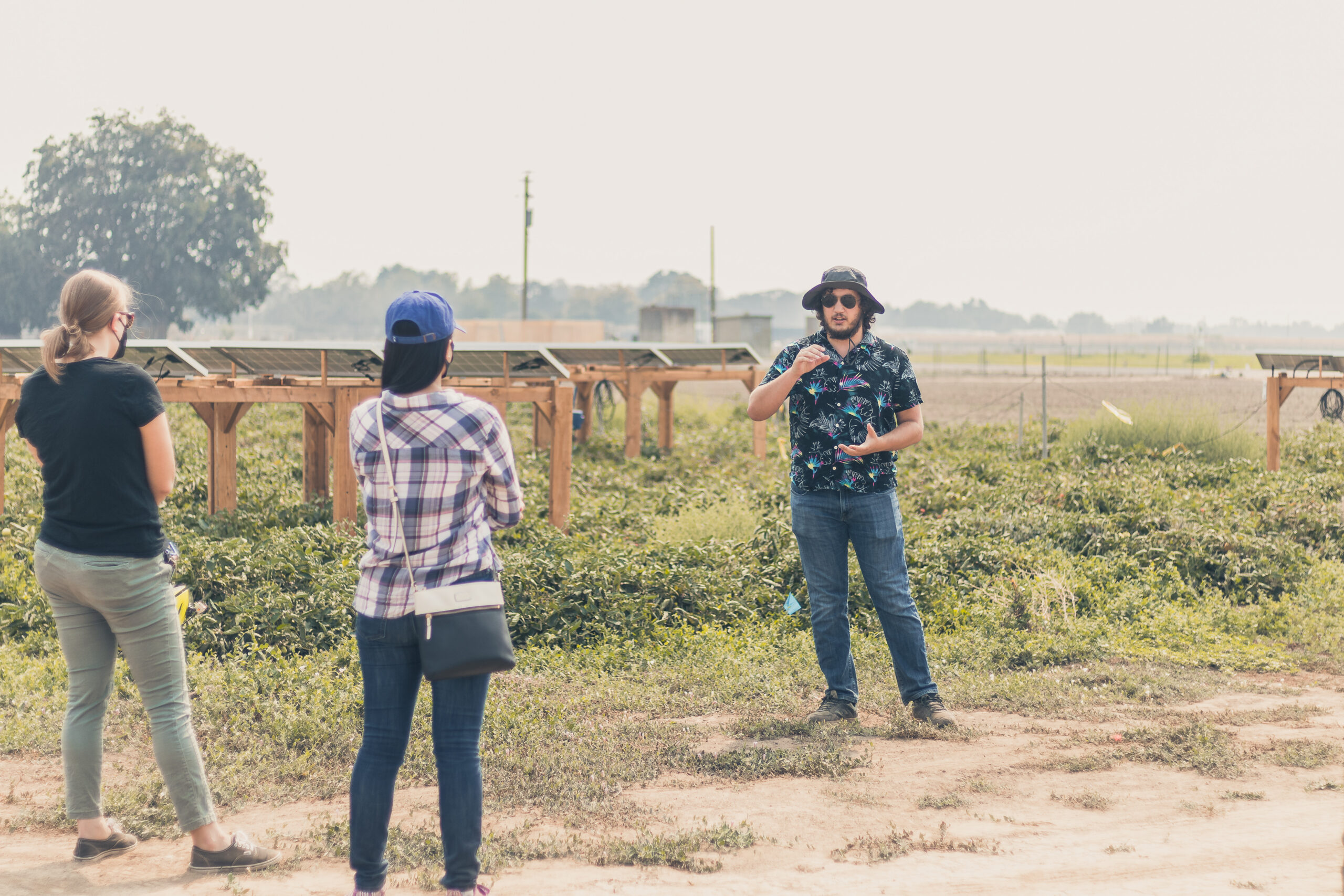
Photo: Nikita Mistry / UC Davis, via UC Davis College of Engineering and Wikimedia Commons. Licensed under CC BY 2.0.

THE HORIZON
Agrivoltaics on the Horizon
Solar panels could help some farms conserve water and diversify income. Making the idea work in the Central Valley will take careful choices about crops, costs and the future of agricultural land.
California’s Central Valley has built an agricultural economy around abundant sunshine and the ability to move water where crops need it. Now that same sunshine is drawing interest for another harvest: electricity.
The two uses can compete for land. Solar development offers a possible income source as groundwater constraints reshape farming, but replacing crops with panels raises questions about agricultural jobs, food production and the future of rural communities.
Agrivoltaics proposes a different arrangement: design solar installations so crops or livestock remain part of the working landscape. The prospect is appealing. An acre might produce food and electricity while using less irrigation water. Whether it delivers those benefits, however, depends on what grows there, how the panels are arranged and whether the farming remains economically viable.
For the Northern San Joaquin Valley, the useful question is becoming more specific than whether agriculture and solar can coexist. It is where they can coexist successfully—and who benefits when they do.
One Acre, Two Uses
Agrivoltaics involves agricultural production beneath or between solar panels. Elevated arrays can leave space for crops and equipment; vertical panels can stand between cultivated rows; grazing animals can use vegetation around conventional installations. These arrangements differ substantially in cost, management and agricultural output.
That distinction matters when evaluating a proposed project. Sheep grazing beneath panels is agricultural production, but it does not preserve the same products, employment or supporting businesses as the irrigated crop operation it might replace. Likewise, putting solar on a farm does not automatically make it agrivoltaics. Panels occupying a separate field while agriculture continues elsewhere are not sharing the same productive acreage.
The strongest case for dual use is that each activity can retain value without requiring its own full land footprint. But combined productivity should not obscure the individual results. A project can increase total revenue while reducing food output. Communities need to understand both outcomes.
The Water Promise—and Its Limits
A California suitability analysis by UC Berkeley researcher Sarah Sarfaty Epstein identifies more than 2 million acres of farmland with potential for agrivoltaics. Suitable areas cluster in 15 groundwater subbasins across the San Joaquin, Sacramento and Salinas valleys.
According to the Berkeley Food Institute, the analysis estimates annual water savings of roughly 0.5 to 1.2 acre-feet per acre. Across the entire identified footprint, the estimates reach approximately 1.1 million to 2.5 million acre-feet annually.
An acre-foot is enough water to cover an acre of land one foot deep—about 326,000 gallons. At the scale of the Valley, even modest savings per acre could become significant.
Those estimates describe modeled possibilities, not water already conserved. The analysis identifies places worth investigating; it does not establish that every mapped parcel can support a financeable project or that all suitable acreage will be developed. Actual savings depend on crops, climate, array design and irrigation practices.
The physical mechanism is plausible. Partial shade can lower daytime temperatures and reduce the atmosphere’s demand for water. Research at the University of Arizona found that shaded growing conditions altered soil moisture, plant water loss and crop performance. But responses differed among crops, underscoring why one irrigation-saving percentage cannot describe every farm.
There is also an accounting question. More crop production per gallon is improved water-use efficiency; it is not necessarily less groundwater pumping overall. Groundwater agencies must also consider changes in irrigated acreage and water use elsewhere. If water saved on one field supports additional irrigated production on another, the aquifer may gain less than the original field’s results suggest.
For local groundwater agencies, the relevant test is therefore measured, sustained improvement in the basin’s water budget.
What Will Grow Under the Panels?
Plants need sunlight, but more exposure does not always mean a better harvest. In very hot conditions, partial shade can ease stress. In other circumstances, reduced light can constrain growth.
A University of Arizona study published in 2019 illustrates that variability. Researchers tested chiltepin peppers, jalapeños and cherry tomatoes beneath solar panels. Chiltepin and tomato production increased relative to the open plots, while jalapeños produced similar amounts with less water lost through transpiration. These were results from a particular experimental setting, not yield forecasts for California farms.
California research is examining its own conditions. UC Davis described a one-acre experiment in 2024 involving peppers and tomatoes exposed to different combinations of light, irrigation and soil conditions. Treatments included partial shading from vertical solar panels, with fully sunlit, adequately irrigated plants providing a comparison.
Such work helps move the discussion beyond whether plants can survive beneath panels. Growers need to know whether marketable yields, quality and harvest timing justify the investment.
A trial showing healthy pepper plants cannot establish that a commercial almond orchard will work beneath the same structure. Permanent plantings require a design that accommodates mature canopies and years of management. Equipment access, pruning, spraying and harvest operations must fit around infrastructure that may remain for decades.
Nor does success with a specialty vegetable automatically translate into an alternative for a large forage operation. Crop suitability is only part of the decision. Labor requirements, buyers, equipment and the farm’s existing business all matter.
Design Starts With the Farm
An agrivoltaic project is an exercise in sharing sunlight and space. Higher panels may improve access, while wider spacing can leave more room and light for agriculture. Those choices also change construction costs and electricity production per acre.
The National Renewable Energy Laboratory identifies panel height, racking, equipment, installation labor and site preparation among the factors affecting project costs. Its research also emphasizes compatibility between agricultural operations and permanent energy infrastructure.
For a grower, the practical questions begin at ground level. Can equipment turn at the end of a row? Can an irrigation line be repaired without disrupting electrical infrastructure? Will a future crop rotation remain possible? Who has access during harvest or equipment maintenance?
These questions should shape the layout before construction. Retrofitting a farm operation around a completed array can leave agriculture with whatever space happens to remain.
Grazing offers a different model and is an established part of American agrivoltaics. The U.S. Department of Energy has identified sheep grazing and pollinator habitat as prominent uses among documented projects. Growing commercial crops beneath arrays presents additional operational demands.
A grazing project can be worthwhile on its own terms. Its benefits should be assessed according to what it actually produces and maintains, rather than treated as proof that every form of Valley agriculture can fit beneath panels.
Two Revenue Streams, One Complicated Business
Energy income can help diversify a farm’s finances, but the arrangement determines who receives that income and who assumes the risk.
A landowner leasing acreage to a developer has a different business proposition from a grower borrowing money to own an installation. A tenant farmer may face another calculation entirely, especially if continued access depends on an agreement between the property owner and an energy company.
The Department of Energy notes that agrivoltaic systems generally carry higher capital costs than conventional solar because structures, design and installation may be more complex. Worker safety, liability and business arrangements also require attention.
Consequently, claims that electricity earns more per acre than crops are insufficient to establish a project’s value. A useful comparison must account for financing, agricultural revenue, operating expenses, maintenance responsibilities and the terms governing the land.
Before signing, the parties need clear answers about crop damage, access, insurance and responsibility when equipment fails. They also need an end-of-project plan: who removes the infrastructure, who pays and what condition the soil must be left in.
Solar installations can operate for 25 years or longer, according to the Department of Energy. That makes the agreement a long-term land-management decision as well as an energy investment.
Why the Northern Valley Has a Stake
Around Turlock, the future of groundwater is already shaping local planning. California’s Sustainable Groundwater Management Act, commonly called SGMA, requires local agencies in high- and medium-priority basins to plan for and achieve sustainable groundwater use. The California Department of Water Resources approved the revised Turlock Subbasin Groundwater Sustainability Plan on February 27, 2025, following an earlier determination that the plan was incomplete.
Approval did not mean the groundwater problem was solved. The state’s determination called for continued monitoring and identified recommended corrective actions. It also set January 28, 2027, as the deadline for the agencies’ periodic evaluation.
That distinction provides useful context for agrivoltaics. A promising technology becomes relevant to groundwater management when its results can be demonstrated and incorporated into an actual plan.
For growers and officials in Stanislaus, Merced and San Joaquin counties, a sensible next step would be demonstrations tied to identifiable local needs. A trial should compare crop performance and water use against a credible conventional baseline while recording the costs of operating both systems.
Those comparisons should include difficult years. A successful season provides information; several seasons reveal more about reliability, maintenance and changing weather.
Regional planning also needs multiple options. Public Policy Institute of California research identifies solar development, groundwater recharge, habitat restoration and water-limited cropping among possible uses for land affected by declining irrigation supplies. Agrivoltaics deserves consideration within that wider set of choices. The best use of a particular parcel may depend as much on its location and water conditions as on the technology available.
Protecting the Agricultural Promise
Farmland protections add another layer. California’s Williamson Act enables agricultural land conservation through contracts, and the compatibility of solar development depends on local rules and the particular contract. State Department of Conservation guidance makes clear that local treatment of electrical facilities varies.
A project’s agrivoltaic description therefore does not settle its land-use status. Growers and developers still need to establish which requirements apply to their property and proposed operation.
For policymakers, there is a separate question: what should qualify as meaningful agricultural production when a project seeks recognition or support for dual use?
A credible standard could require an agricultural management plan, reporting on production and water use, and a process for addressing prolonged abandonment of farming. Requirements should accommodate legitimate changes in crops and weather while making the original promise assessable.
The distribution of benefits matters, too. Berkeley researchers studying agrivoltaics have explicitly raised questions about access for small and midsize farms and benefits for workers and surrounding communities. Those concerns belong in project evaluation from the beginning.
A profitable lease for one property owner is one outcome. Maintaining viable farm businesses, useful employment and a healthier groundwater system are additional outcomes that require their own evidence.
A Practical Test for the Valley
Agrivoltaics has moved beyond an abstract idea. Research plots and operating projects demonstrate that solar generation can share land with agricultural activity. The remaining challenge is matching that possibility to the Valley’s crops, business conditions and water constraints.
The strongest projects will make their tradeoffs visible. They will show how much food or forage remains in production, how much electricity reaches a useful market, what happens to water use and whether the combined operation can support its costs.
For the Northern San Joaquin Valley, the opportunity is worth examining farm by farm. Some farms may find a durable second source of income. Others may discover that their crops, equipment or land are better suited to a different approach.
The Valley can grow food and power together. The measure of success will be whether doing so helps sustain the farms and communities that depend on the land.