Tag: California

  • The Forgotten Towns of the Valley: Places That Still Hold the Region Together

    The Forgotten Towns of the Valley: Places That Still Hold the Region Together

    ROOTS & DUST

    Across the Valley and its foothills, there are places that no longer command the attention they once did.

    A weathered schoolhouse set back from the road. An old brick storefront with windows darkened by time. A cemetery near the edge of a field. A historic marker beside a quiet highway. A main street that may no longer bustle, but still carries the memory of the people who passed through it, built around it, and called it home.

    These are the smaller towns and crossroads communities of the Valley.

    Some were ferry points. Some were grain depots. Some were stage stops, mining supply centers, agricultural service towns, or foothill settlements tied to older routes of trade and travel. They had stores, churches, schools, boarding houses, post offices, warehouses, and gathering places. They gave people a reason to stop, trade, worship, work, settle, and belong.

    Today, some of these places are quieter than they once were. Some have been bypassed by highways, overshadowed by larger cities, or folded into the broader geography of modern life. Others remain as historic districts, rural communities, scenic stops, or names that still mean something to the families and residents who know their stories.

    But quieter does not mean unimportant.

    The smaller towns of the Valley remain part of the region’s fabric. They remind us that the Valley was not built only by its largest cities, major highways, and expanding suburbs. It was also built by modest communities that served farmers, miners, merchants, travelers, immigrants, ranching families, and working people who needed local places to gather and endure.

    Their importance is not measured only by population or economic output. It is found in memory, identity, landscape, architecture, family history, and the continuity they provide between the Valley’s past and present.

    To understand the Valley fully, we have to understand these places too.

    When Small Places Were Essential

    In the nineteenth and early twentieth centuries, the Valley and its nearby foothills were far more locally organized than they are today. Travel was slower. Roads were rougher. Markets were more fragmented. A community did not need to be large to matter. It needed only enough people and enough purpose to justify a store, a blacksmith, a school, a church, a warehouse, or a post office.

    A ferry crossing could create a settlement. So could a rail siding, a stage route, a grain warehouse, a mining supply road, or a cluster of farms needing a common center.

    In a landscape not yet tied together by highways, refrigeration, centralized processing, and large retail centers, small towns were not marginal. They were essential.

    They were where people collected mail, bought supplies, exchanged news, sent children to school, repaired equipment, worshiped, voted, traded crops, and built local identity. Their scale may have been modest, but their role was real.

    That is why the older map of the Valley looks so different from the modern one. There were more little centers of life, more crossroads, more local gathering places, more communities serving narrow but meaningful circles of settlement.

    Many of those places never became large cities. But they helped make larger growth possible.

    A Network of Memory

    As transportation improved, agriculture changed, schools consolidated, and commerce moved toward larger centers, many small towns lost some of the practical advantages that had once sustained them. A depot mattered less. A local store faced harder competition. A school district merged. A post office closed or moved. A main street that once served as a destination became a pass-through.

    But this should not be read only as decline.

    It is also a story of adaptation.

    Some communities survived by becoming heritage destinations. Some remained rural residential communities. Some became quiet agricultural settlements. Some preserved cemeteries, churches, meeting halls, schoolhouses, bridges, or annual traditions that continue to hold people together.

    Others live through family names, local museums, historical societies, ranch roads, old photographs, and stories told across generations.

    The Valley’s smaller towns are part of a network of memory. They hold evidence of how people lived before the region became so concentrated around larger cities and corridors. They show a Valley of more local centers, more intimate economies, and more varied forms of community life.

    They are not simply places left behind.

    They are places that still help explain where the Valley came from.

    Knights Ferry: A Town That Became a Landmark

    Knights Ferry in Stanislaus County offers one of the clearest examples.

    Originally a ferry crossing on the Stanislaus River during the Gold Rush era, Knights Ferry became a busy supply town with hotels, mills, stores, and commercial importance far beyond its current size. It served movement. It served trade. It served an older geography in which river crossings and early roads mattered enormously.

    Over time, larger transportation systems emerged, commerce concentrated elsewhere, and Knights Ferry’s old economic role changed. But the town did not disappear.

    It became something different.

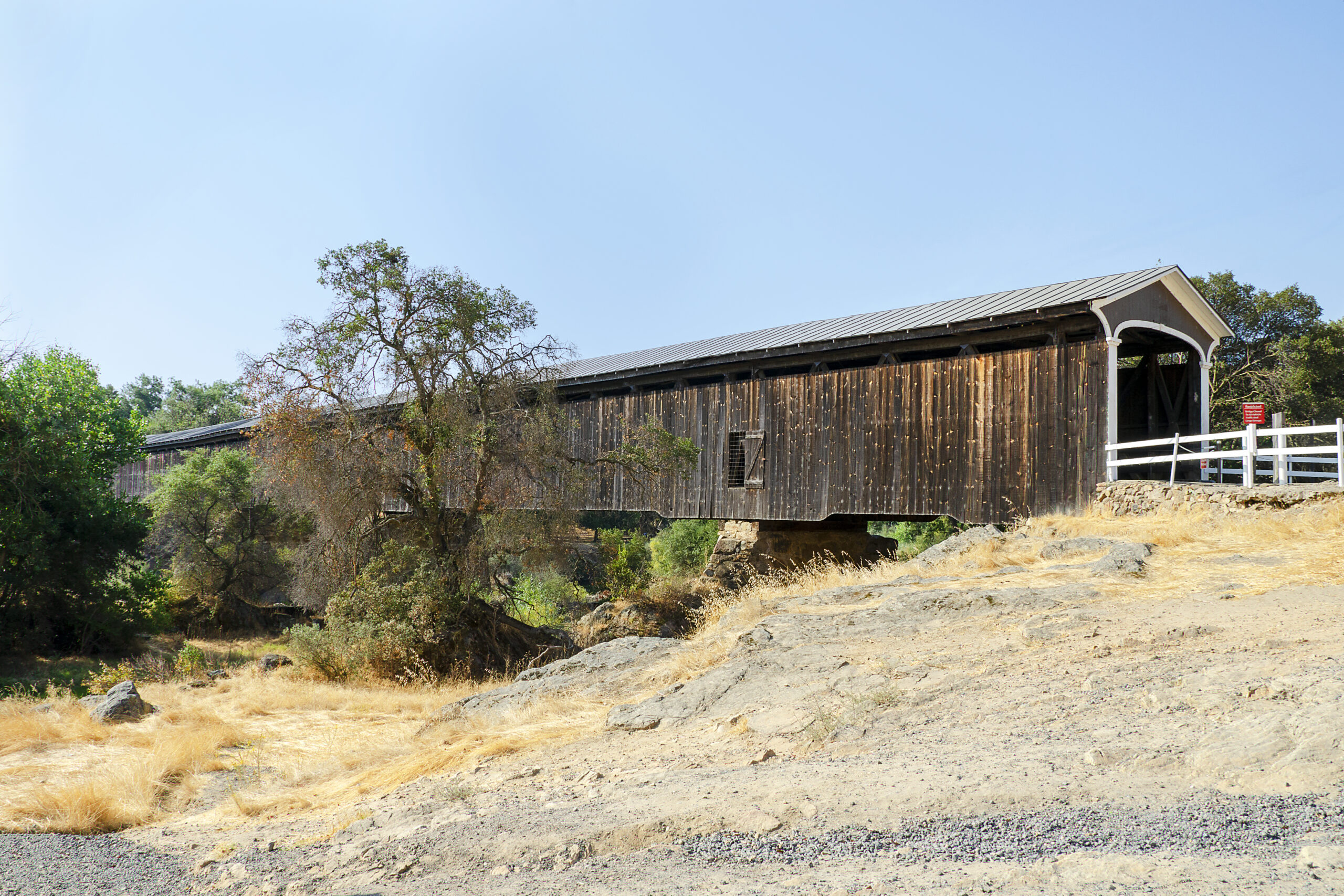
    Today, Knights Ferry endures as a historic district, scenic destination, and one of the most recognizable heritage places in the region. Its covered bridge, river setting, old buildings, and preserved atmosphere give residents and visitors a direct connection to an earlier California.

    Its value is no longer measured by the number of wagons, miners, farmers, or merchants passing through. Its value is found in what it preserves.

    Knights Ferry reminds us that a town can lose one kind of importance and gain another.

    It may no longer drive the regional economy, but it anchors regional memory.

    La Grange and Civic Heritage

    La Grange tells a related story.

    In the 1850s through the 1870s, La Grange was a mining and farming center of genuine consequence. It even served briefly as a county seat, which tells us something important about its former status. Places do not become county seats by accident. They become county seats because, for a time, they appear central to the political and economic life of a region.

    That centrality later moved. County functions shifted. Irrigation-era development favored other corridors. Commerce chose different routes.

    But La Grange still matters.

    Its stone buildings, old jail, historic texture, and foothill setting remain part of the Valley’s civic inheritance. The town carries evidence of a time when political importance was still unsettled and when the geography of power looked different than it does today.

    La Grange helps us remember that the Valley’s present map was not inevitable. It was built through choices, movement, investment, and change.

    That makes places like La Grange more than historical curiosities. They are reminders that civic life has roots deeper than today’s city boundaries.

    Snelling, Hopeton, and the Older Map of Movement

    Across Merced County and beyond, communities such as Snelling and Hopeton also reveal the older structure of regional life.

    They served agricultural families, travelers, and foothill commerce when local geography gave them practical importance. Snelling, with its historic courthouse and connection to early Yosemite travel routes, remains a proud reminder of how movement once passed through different places than it does today.

    These communities may not dominate the modern map, but they still contribute to the Valley’s identity.

    They show that the region was shaped not only by its largest cities, but also by smaller places that connected farms, roads, rivers, foothills, and families.

    In that sense, they remain part of the Valley’s living geography.

    The Foothill Edge and a More Complicated History

    Further east and south, places like Chinese Camp in Tuolumne County and Hornitos in Mariposa County preserve another dimension of the region’s story.

    Chinese Camp was once home to one of the largest Chinese communities in California during the mining period, a reminder that early inland history was more globally layered than many simplified versions of the past suggest. Hornitos, known for its frontier reputation and distinctive architecture, still carries the atmosphere of an older California shaped by mining, migration, trade, and survival.

    These places matter because they complicate the story.

    They remind us that the Valley and foothills were never one thing. They were agricultural and industrial, rural and connected, local and international, settled by many peoples for many reasons.

    Forgotten towns preserve evidence of that complexity.

    They help tell a fuller story of who lived here, how they lived, and what kinds of communities once seemed possible.

    The Value of Quiet Places

    Not every important town has a dramatic story.

    Some were modest crossroads communities on the Valley floor. Some formed around schools, stores, churches, post offices, or grain points. Some served dispersed farm families. Some never grew large enough to become widely known beyond their immediate area.

    But smallness does not erase significance.

    These places were part of the daily structure of life. They gave rural families a center. They created local relationships. They held meetings, services, celebrations, funerals, elections, and ordinary conversations. They helped turn open land into community.

    As agriculture consolidated and transportation improved, some of these places became quieter. But even when their institutions faded, their meaning often remained.

    A town becomes a crossroads. The crossroads becomes a name. The name becomes a memory. And memory, in a region that changes as quickly as the Valley, is no small thing.

    What These Places Teach

    The smaller towns of the Valley teach several important lessons.

    They teach that transportation shapes destiny. Roads, rail lines, river crossings, and highways determine which places grow and which become quieter.

    They teach that water and infrastructure matter. Communities tied to major irrigation systems, public investment, and market access gained advantages others did not.

    They teach that modernization is uneven. Growth can create thriving centers while also changing the role of smaller communities.

    They teach that identity is not only found in major cities. It lives in churches, cemeteries, bridges, storefronts, schools, local traditions, and family stories.

    Most of all, they teach that the Valley is more than its biggest places.

    To understand the region, we need to understand its quieter places too.

    Why They Still Matter

    The smaller towns of the Valley offer more than nostalgia.

    They offer perspective.

    Their old depots, brick storefronts, schoolhouses, cemeteries, churches, bridges, and main streets are not simply leftovers from another era. They are records of how the region was built — by movement, labor, faith, trade, family, ambition, hardship, and hope.

    They remind us that the Valley’s story is not only about expansion. It is also about continuity.

    Some places grow large. Some remain small. Some change purpose. Some survive mainly through memory. But each contributes something to the region’s deeper identity.

    Drive the back roads between the larger towns and you can still see them.

    A historic marker beside a quiet road.
    A small church still standing.
    A cemetery holding generations of names.
    A few old buildings with more history than traffic.
    A town that may not be loud, but still belongs.

    These places are not truly forgotten if we choose to remember them.

    They remain part of the fabric of the Valley — quiet, enduring, and essential to understanding the place we call home.

    They remain as a quiet warning too: every thriving center is more fragile than it appears, and every map of progress leaves something behind.

  • Gold Country’s Lasting Influence on Modern Valley Communities

    Gold Country’s Lasting Influence on Modern Valley Communities

    ROOTS & DUST

    Drive east from Modesto, Turlock, or Stockton and the land begins to change. The flat floor of the Valley gives way to rolling ground, oak woodland, exposed stone, winding rivers, and the first clear rise toward the Sierra Nevada foothills. It is not an abrupt transformation. It is a gradient — one landscape leaning into another.

    That transition matters because the Valley and Gold Country have never been separate worlds.

    The Mother Lode holds a special place in California’s imagination. It is remembered as the place where gold drew dreamers, opportunists, laborers, merchants, and migrants from around the world after James Marshall’s 1848 discovery at Sutter’s Mill. It was a world of camps, rivers, claims, violence, improvisation, sudden wealth, and sudden failure.

    But Gold Country did not simply blaze and vanish. It sent people, money, habits, skills, and stories downhill. Its influence settled into the communities of the lower foothills and Valley floor, helping shape the character of towns across Stanislaus, San Joaquin, Calaveras, Tuolumne, Mariposa, and surrounding counties.

    The gold itself was concentrated in the hills. The legacy was not.

    To understand many modern Valley communities, the foothills have to be taken seriously — not just as scenery or weekend territory, but as one of the formative sources of the region’s civic and cultural identity.

    After the Rush Came Settlement

    The Gold Rush is usually remembered for arrival. Its longer regional importance rests just as much in what happened after the first frenzy.

    Between 1849 and the mid-1850s, hundreds of thousands of people came to California in pursuit of fortune. Many passed through. Many failed. Some prospered. Countless others simply endured. What they encountered in the foothills was not stable prosperity, but instability on a grand scale. Easy placer gold declined. Competition intensified. Camps rose and disappeared. Risk remained high, and permanence was scarce.

    For many, the more durable opportunity lay below.

    The fertile lands of the San Joaquin Valley offered something the mining camps could not: room, climate, and the possibility of building a life less dependent on luck. Former miners, merchants, transport operators, and camp survivors moved downslope in search of steadier work and settlement. Some purchased land. Some opened stores. Some entered livestock, grain, transport, or later fruit agriculture. Others carried the habits of a volatile frontier into towns that were still trying to define themselves.

    This movement mattered because it linked two regional economies that are often treated separately. Gold Country produced the first great population shock. The Valley absorbed much of its aftermath.

    That is one reason so many communities still carry a faint but durable frontier residue. Their founders were not only farmers in the classic sense. Many were people who had already lived through mobility, risk, and reinvention in the foothills before trying to build something more permanent below.

    The result was not just demographic growth. It was a transfer of temperament.

    Skills That Traveled Downhill

    One of Gold Country’s lasting contributions was practical skill.

    Mining camps demanded improvisation. Water had to be moved. Claims had to be organized. Materials had to be transported. Hillsides had to be worked. Risk had to be judged quickly, often with little certainty and limited formal structure.

    These were not polished civic habits. But they were useful ones.

    Men who had worked around ditches, flumes, and water diversions in the foothills did not arrive in the Valley as blank slates. They brought familiarity with gravity flow, crude hydraulic systems, shared-use customs, and the practical mentality needed to organize labor around scarce resources. They also brought a tolerance for infrastructure. A person shaped by mining culture was often prepared to think in terms of systems, tools, water, and terrain.

    This does not mean mining directly created the Valley’s irrigation systems in a simple way. That would overstate the case. But the foothill world helped cultivate a population already accustomed to managed resources, local rules, and technical adaptation.

    That inheritance mattered.

    Gold Country taught people how to build under pressure, how to work with difficult terrain, and how to treat water not merely as scenery, but as a problem to be organized.

    Money, Markets, and Movement

    Gold did not remain in the hills.

    Some of it flowed downward in the form of investment. People who made money, or enough money to matter locally, often reinvested in land, stores, cattle operations, milling, transport, and other commercial ventures outside the camps. Valley land offered a different kind of opportunity: not sudden wealth, but durable asset-building.

    Mining camps also needed food, tools, animals, lumber, and freight. The Valley supplied grain, livestock, produce, and later broader agricultural output. Foothill towns such as Sonora, Angels Camp, and Jamestown became supply points and market nodes tied to a wider regional economy. The camps needed sustenance. The Valley needed markets. Between them developed a relationship more integrated than later histories often suggest.

    Even after the first mining boom faded, the connection endured. Hard-rock mining, lumber, ranching, and later tourism kept the foothills economically linked to the Valley. The terms changed, but the relationship remained.

    That is still visible today. Many Valley families have long maintained ties to foothill towns, mountain property, recreation routes, or seasonal traditions. The line between Gold Country and Valley life has always been more porous than the map suggests.

    A Culture of Self-Reliance

    If Gold Country left behind anything especially durable, it may be attitude.

    Mining communities were often suspicious of distant authority, dependent on local arrangements, and shaped by personal initiative. Camps developed rules and customs because they needed order before formal institutions fully arrived. That habit — solving problems locally, trusting practical knowledge, and preferring direct control — left a mark on the broader region.

    This helps explain why many Valley communities have long preferred local solutions, especially on land, water, and governance. The pattern cannot be explained entirely by Gold Country, but the inheritance helps.

    A miner’s suspicion of distant power could become a farmer’s defense of local water control. A camp-built norm of practical self-rule could later translate into support for districts, local boards, and civic arrangements designed to keep decision-making close to the ground.

    This is why public infrastructure in the Valley often carries symbolic meaning beyond utility. Canals, roads, schools, districts, and local institutions represent more than services. They reflect a tradition of practical self-government in a region accustomed to building for itself.

    That spirit remains part of the Valley’s civic style.

    Migration, Diversity, and Reinvention

    The Gold Rush also introduced one of California’s first great waves of modern diversity.

    The mines drew people from the eastern United States, Europe, Mexico, Chile, China, and elsewhere. Many faced exploitation, exclusion, or violence. Many moved repeatedly. But the larger fact remains: the foothills became one of the first places in California where layered migration took shape at dramatic scale.

    That pattern did not end in the camps.

    As some mining communities declined or stabilized, parts of that diverse population moved into lower-elevation settlements and emerging Valley towns. Later migrations — Armenians, Portuguese, Dust Bowl families, Hmong, Latinos, and many others — would alter the region further. But the foothill world helped establish a precedent: the Valley would be built by successive waves of newcomers, not by one founding population.

    This is one reason the region’s social history is best understood as repeated incorporation. People arrived in search of work, land, affordability, refuge, or second chances. They reshaped the place and were reshaped by it.

    Gold Country helped normalize that condition.

    Family Memory and Regional Identity

    In many Valley families, Gold Country survives less as textbook history than as ancestry.

    Oral histories often carry some version of the same story: a grandfather who mined before farming, a relative who passed through Sonora or Angels Camp before settling on Valley land, a family business that began in camp trade before moving into agriculture or town commerce. Not every story is exact. Some have been polished by memory. But their persistence matters.

    The foothills remain part of how many communities imagine where they came from.

    Identity is not built only from infrastructure. It is also built from usable stories. Gold Country offers the Valley a language of grit, reinvention, and earned permanence. The camps themselves were unstable, but the memory of people leaving them to build something more durable below became a powerful regional lesson: settlement over speculation, endurance over frenzy, construction over extraction.

    That helps explain the recurring Valley admiration for hard work, local initiative, toughness, and unadorned practicality. These are not just generic rural virtues. They are part of a deeper regional self-image shaped in part by the passage from mining camp to settled farm town.

    Why the Foothills Still Matter

    The Gold Rush is over. The camps are now museums, tourist towns, historic districts, living communities, or some combination of all four. The foothills are no longer a frontier. But their influence remains active.

    Local fairs, Mother Lode celebrations, historical societies, and family traditions keep the connection visible. More importantly, the relationship still persists in quieter forms: landownership patterns, family geography, recreation, tourism, lifestyle identity, and regional memory.

    That matters at a moment when the Valley faces new pressures — water limits, housing growth, land-use conflict, environmental stress, and economic change. The old Gold Country legacy offers both inspiration and warning. It reminds the region that adaptation, improvisation, and institutional creativity are not new. But it also reminds us that booms can distort communities, that infrastructure choices shape generations, and that what looks temporary at first can leave permanent marks.

    Those are not antiquarian lessons. They are modern ones.

    The Sierra foothills east of the Valley are more than scenery. They are part of the region’s formative structure. Gold Country helped shape the Valley not only by producing wealth, but by sending people, practices, expectations, and stories into the communities below.

    The modern Valley cannot be reduced to that inheritance. Too much has happened since: agriculture, irrigation, migration, urban growth, public institutions, and industry have all added layers of their own. But the foothill influence remains part of the deeper foundation.

    When you drive east from Modesto or Turlock and the Sierra begins to rise in the distance, you are not just looking at a neighboring landscape. You are looking at one of the sources of the region’s character.

    Gold drew dreamers into the hills.

    What followed helped build something far more lasting in the rich soil below.

  • Why California’s Central Interior Deserves Deeper Coverage

    Why California’s Central Interior Deserves Deeper Coverage

    Every place has a story. Some stories are told often. Others are overlooked, simplified, or forgotten. For generations, the communities of California’s interior have helped feed the nation, power the state’s economy, shape its politics, and preserve some of its deepest cultural memory. Yet too often, the region is treated as background, mentioned in passing, reduced to stereotypes, or understood only through crisis.

    Caliture begins from a different premise: California’s Central Interior deserves to be understood on its own terms. This publication was created to cover the region with patience, rigor, and clarity, bringing thoughtful journalism, historical storytelling, civic intelligence, and future-focused analysis to the communities that call California’s interior home.

    Our first region is also our home and our starting point. From the fertile valley floor to the foothills of Gold Country, the Central Interior is a place where agriculture, commerce, history, innovation, and community intersect. It is defined not only by what it produces, but by the people who live here, build here, remember here, and invest in what comes next.

    What Is Caliture?

    Caliture is a digital publication dedicated to covering life across California through three lenses: the past that shaped us, the present that defines us, and the future we are building together. Our mission is simple: to record life as it was, is, and can be.

    We believe good journalism should do more than report events. It should help people understand where they live, how their communities function, and what forces are shaping the future around them. That means exploring local history, explaining public policy, examining economic trends, highlighting cultural institutions, and connecting individual communities to the broader story of California.

    In an era of shrinking local newsrooms and fragmented information, Caliture seeks to provide context, perspective, and a deeper understanding of the places we call home. Our editorial approach is built around depth and readability, with reporting designed for readers who want context rather than noise.

    The Central Interior

    The Central Interior serves as Caliture’s launch region. It includes communities across San Joaquin County, Stanislaus County, Merced County, Calaveras County, Tuolumne County, and Mariposa County. Together, these counties form one of California’s most important crossroads.

    Agricultural towns sit alongside growing regional cities. Historic Gold Rush communities share economic ties with modern logistics corridors. Family farms operate near emerging industries. Long-standing traditions meet new pressures, new people, and new opportunities. Each community has its own identity, but many of the region’s most important issues are shared.

    • Water
    • Housing
    • Transportation
    • Economic development
    • Education
    • Public safety
    • Preserving local character while preparing for future growth

    These challenges rarely stop at city limits or county lines. Understanding them requires looking at the region as a whole. That is why the Central Interior matters, and why it deserves deeper coverage.

    How to Read Caliture

    Caliture is organized around three levels of coverage: Local, Regional, and Republic.

    Local

    Every story begins somewhere. Local coverage focuses on individual communities, institutions, and the people who shape them. These stories examine the character of towns, neighborhoods, schools, businesses, and local governments throughout the Central Interior. Local reporting helps us understand the places closest to home.

    Regional

    Many issues extend beyond a single city or county. Regional coverage connects the dots between communities and examines the trends, industries, infrastructure systems, and public policies that influence the broader region. Whether discussing water management, transportation networks, agriculture, housing, or economic development, regional reporting helps readers see the larger picture.

    Republic

    Some decisions made far from home eventually shape daily life here. Republic coverage examines statewide and national issues through the lens of how they affect California’s interior communities. The goal is not simply to report what is happening in Sacramento or Washington, but to understand what those decisions mean for the people, cities, farms, schools, businesses, and institutions of the Central Interior.

    Our Editorial Framework

    Every article published by Caliture falls within one of three editorial sections.

    Roots & Dust

    The Past. Roots & Dust explores history, heritage, geography, culture, and the people who shaped the communities we know today. This is where Caliture looks back, not out of nostalgia alone, but because the past still lives in the land, the towns, the roads, the institutions, and the memory of the region.

    The Civic Commons

    The Present. The Civic Commons examines public policy, government, community affairs, economics, and the institutions that influence daily life. This is where Caliture explains how things work now, how decisions are made, how public money is spent, how communities grow, and how civic life takes shape.

    The Horizon

    The Future. The Horizon looks ahead at infrastructure, education, innovation, workforce development, technology, water, and long-term regional growth. This is where Caliture examines what the Central Interior may become and what choices will shape that future.

    Life as it was, is, and can be.

    Why It Matters

    Strong communities require informed citizens. Strong regions require shared understanding. And California’s future depends, in part, on places that often receive less attention than they deserve despite contributing so much to the state’s success.

    The Central Interior is not a side note to California’s story. It is one of the places where the future of the state is being negotiated in real time. Growth pressures, environmental constraints, public investment, and demographic change are reshaping the region, often outside the spotlight. Caliture exists to bring those developments into focus with reporting that is measured, independent, and regionally informed.

    The Central Interior deserves journalism that takes its people, institutions, history, culture, and future seriously. That is the purpose of Caliture. This is our first region, our first chapter, and just the beginning. Over time, Caliture will expand into additional regions across California’s interior, but for now our focus remains on building a publication worthy of the Central Interior and the people who call it home.

    Caliture
    California: In Focus.
    Local. Regional. Republic.