Tag: California

  • Can the Valley Grow Food and Power at the Same Time?

    Can the Valley Grow Food and Power at the Same Time?

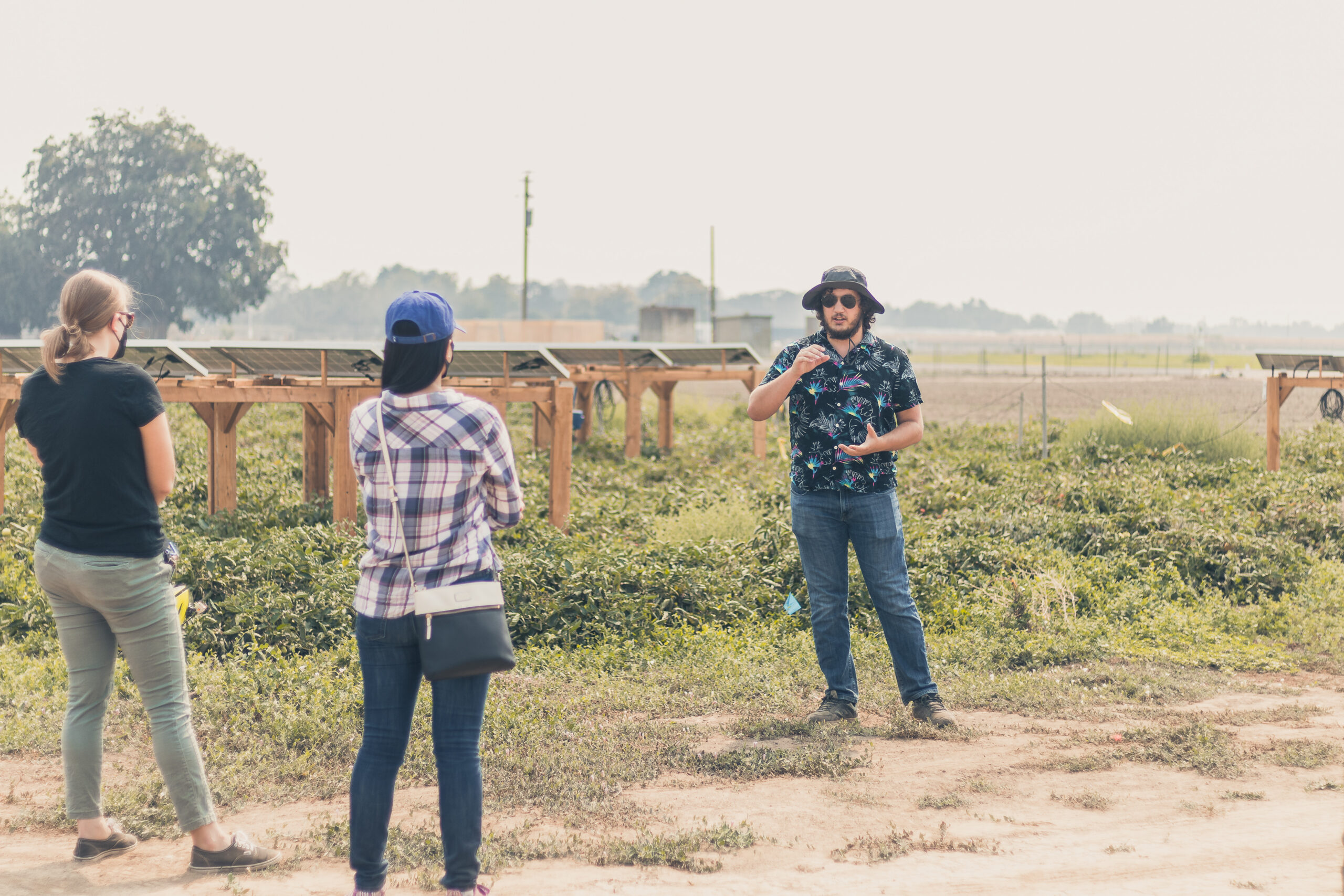
    Photo: Nikita Mistry / UC Davis, via UC Davis College of Engineering and Wikimedia Commons. Licensed under CC BY 2.0.

    THE HORIZON

    Agrivoltaics on the Horizon

    Solar panels could help some farms conserve water and diversify income. Making the idea work in the Central Valley will take careful choices about crops, costs and the future of agricultural land.

    California’s Central Valley has built an agricultural economy around abundant sunshine and the ability to move water where crops need it. Now that same sunshine is drawing interest for another harvest: electricity.

    The two uses can compete for land. Solar development offers a possible income source as groundwater constraints reshape farming, but replacing crops with panels raises questions about agricultural jobs, food production and the future of rural communities.

    Agrivoltaics proposes a different arrangement: design solar installations so crops or livestock remain part of the working landscape. The prospect is appealing. An acre might produce food and electricity while using less irrigation water. Whether it delivers those benefits, however, depends on what grows there, how the panels are arranged and whether the farming remains economically viable.

    For the Northern San Joaquin Valley, the useful question is becoming more specific than whether agriculture and solar can coexist. It is where they can coexist successfully—and who benefits when they do.

    One Acre, Two Uses

    Agrivoltaics involves agricultural production beneath or between solar panels. Elevated arrays can leave space for crops and equipment; vertical panels can stand between cultivated rows; grazing animals can use vegetation around conventional installations. These arrangements differ substantially in cost, management and agricultural output.

    That distinction matters when evaluating a proposed project. Sheep grazing beneath panels is agricultural production, but it does not preserve the same products, employment or supporting businesses as the irrigated crop operation it might replace. Likewise, putting solar on a farm does not automatically make it agrivoltaics. Panels occupying a separate field while agriculture continues elsewhere are not sharing the same productive acreage.

    The strongest case for dual use is that each activity can retain value without requiring its own full land footprint. But combined productivity should not obscure the individual results. A project can increase total revenue while reducing food output. Communities need to understand both outcomes.

    The Water Promise—and Its Limits

    A California suitability analysis by UC Berkeley researcher Sarah Sarfaty Epstein identifies more than 2 million acres of farmland with potential for agrivoltaics. Suitable areas cluster in 15 groundwater subbasins across the San Joaquin, Sacramento and Salinas valleys.

    According to the Berkeley Food Institute, the analysis estimates annual water savings of roughly 0.5 to 1.2 acre-feet per acre. Across the entire identified footprint, the estimates reach approximately 1.1 million to 2.5 million acre-feet annually.

    An acre-foot is enough water to cover an acre of land one foot deep—about 326,000 gallons. At the scale of the Valley, even modest savings per acre could become significant.

    Those estimates describe modeled possibilities, not water already conserved. The analysis identifies places worth investigating; it does not establish that every mapped parcel can support a financeable project or that all suitable acreage will be developed. Actual savings depend on crops, climate, array design and irrigation practices.

    The physical mechanism is plausible. Partial shade can lower daytime temperatures and reduce the atmosphere’s demand for water. Research at the University of Arizona found that shaded growing conditions altered soil moisture, plant water loss and crop performance. But responses differed among crops, underscoring why one irrigation-saving percentage cannot describe every farm.

    There is also an accounting question. More crop production per gallon is improved water-use efficiency; it is not necessarily less groundwater pumping overall. Groundwater agencies must also consider changes in irrigated acreage and water use elsewhere. If water saved on one field supports additional irrigated production on another, the aquifer may gain less than the original field’s results suggest.

    For local groundwater agencies, the relevant test is therefore measured, sustained improvement in the basin’s water budget.

    What Will Grow Under the Panels?

    Plants need sunlight, but more exposure does not always mean a better harvest. In very hot conditions, partial shade can ease stress. In other circumstances, reduced light can constrain growth.

    A University of Arizona study published in 2019 illustrates that variability. Researchers tested chiltepin peppers, jalapeños and cherry tomatoes beneath solar panels. Chiltepin and tomato production increased relative to the open plots, while jalapeños produced similar amounts with less water lost through transpiration. These were results from a particular experimental setting, not yield forecasts for California farms.

    California research is examining its own conditions. UC Davis described a one-acre experiment in 2024 involving peppers and tomatoes exposed to different combinations of light, irrigation and soil conditions. Treatments included partial shading from vertical solar panels, with fully sunlit, adequately irrigated plants providing a comparison.

    Such work helps move the discussion beyond whether plants can survive beneath panels. Growers need to know whether marketable yields, quality and harvest timing justify the investment.

    A trial showing healthy pepper plants cannot establish that a commercial almond orchard will work beneath the same structure. Permanent plantings require a design that accommodates mature canopies and years of management. Equipment access, pruning, spraying and harvest operations must fit around infrastructure that may remain for decades.

    Nor does success with a specialty vegetable automatically translate into an alternative for a large forage operation. Crop suitability is only part of the decision. Labor requirements, buyers, equipment and the farm’s existing business all matter.

    Design Starts With the Farm

    An agrivoltaic project is an exercise in sharing sunlight and space. Higher panels may improve access, while wider spacing can leave more room and light for agriculture. Those choices also change construction costs and electricity production per acre.

    The National Renewable Energy Laboratory identifies panel height, racking, equipment, installation labor and site preparation among the factors affecting project costs. Its research also emphasizes compatibility between agricultural operations and permanent energy infrastructure.

    For a grower, the practical questions begin at ground level. Can equipment turn at the end of a row? Can an irrigation line be repaired without disrupting electrical infrastructure? Will a future crop rotation remain possible? Who has access during harvest or equipment maintenance?

    These questions should shape the layout before construction. Retrofitting a farm operation around a completed array can leave agriculture with whatever space happens to remain.

    Grazing offers a different model and is an established part of American agrivoltaics. The U.S. Department of Energy has identified sheep grazing and pollinator habitat as prominent uses among documented projects. Growing commercial crops beneath arrays presents additional operational demands.

    A grazing project can be worthwhile on its own terms. Its benefits should be assessed according to what it actually produces and maintains, rather than treated as proof that every form of Valley agriculture can fit beneath panels.

    Two Revenue Streams, One Complicated Business

    Energy income can help diversify a farm’s finances, but the arrangement determines who receives that income and who assumes the risk.

    A landowner leasing acreage to a developer has a different business proposition from a grower borrowing money to own an installation. A tenant farmer may face another calculation entirely, especially if continued access depends on an agreement between the property owner and an energy company.

    The Department of Energy notes that agrivoltaic systems generally carry higher capital costs than conventional solar because structures, design and installation may be more complex. Worker safety, liability and business arrangements also require attention.

    Consequently, claims that electricity earns more per acre than crops are insufficient to establish a project’s value. A useful comparison must account for financing, agricultural revenue, operating expenses, maintenance responsibilities and the terms governing the land.

    Before signing, the parties need clear answers about crop damage, access, insurance and responsibility when equipment fails. They also need an end-of-project plan: who removes the infrastructure, who pays and what condition the soil must be left in.

    Solar installations can operate for 25 years or longer, according to the Department of Energy. That makes the agreement a long-term land-management decision as well as an energy investment.

    Why the Northern Valley Has a Stake

    Around Turlock, the future of groundwater is already shaping local planning. California’s Sustainable Groundwater Management Act, commonly called SGMA, requires local agencies in high- and medium-priority basins to plan for and achieve sustainable groundwater use. The California Department of Water Resources approved the revised Turlock Subbasin Groundwater Sustainability Plan on February 27, 2025, following an earlier determination that the plan was incomplete.

    Approval did not mean the groundwater problem was solved. The state’s determination called for continued monitoring and identified recommended corrective actions. It also set January 28, 2027, as the deadline for the agencies’ periodic evaluation.

    That distinction provides useful context for agrivoltaics. A promising technology becomes relevant to groundwater management when its results can be demonstrated and incorporated into an actual plan.

    For growers and officials in Stanislaus, Merced and San Joaquin counties, a sensible next step would be demonstrations tied to identifiable local needs. A trial should compare crop performance and water use against a credible conventional baseline while recording the costs of operating both systems.

    Those comparisons should include difficult years. A successful season provides information; several seasons reveal more about reliability, maintenance and changing weather.

    Regional planning also needs multiple options. Public Policy Institute of California research identifies solar development, groundwater recharge, habitat restoration and water-limited cropping among possible uses for land affected by declining irrigation supplies. Agrivoltaics deserves consideration within that wider set of choices. The best use of a particular parcel may depend as much on its location and water conditions as on the technology available.

    Protecting the Agricultural Promise

    Farmland protections add another layer. California’s Williamson Act enables agricultural land conservation through contracts, and the compatibility of solar development depends on local rules and the particular contract. State Department of Conservation guidance makes clear that local treatment of electrical facilities varies.

    A project’s agrivoltaic description therefore does not settle its land-use status. Growers and developers still need to establish which requirements apply to their property and proposed operation.

    For policymakers, there is a separate question: what should qualify as meaningful agricultural production when a project seeks recognition or support for dual use?

    A credible standard could require an agricultural management plan, reporting on production and water use, and a process for addressing prolonged abandonment of farming. Requirements should accommodate legitimate changes in crops and weather while making the original promise assessable.

    The distribution of benefits matters, too. Berkeley researchers studying agrivoltaics have explicitly raised questions about access for small and midsize farms and benefits for workers and surrounding communities. Those concerns belong in project evaluation from the beginning.

    A profitable lease for one property owner is one outcome. Maintaining viable farm businesses, useful employment and a healthier groundwater system are additional outcomes that require their own evidence.

    A Practical Test for the Valley

    Agrivoltaics has moved beyond an abstract idea. Research plots and operating projects demonstrate that solar generation can share land with agricultural activity. The remaining challenge is matching that possibility to the Valley’s crops, business conditions and water constraints.

    The strongest projects will make their tradeoffs visible. They will show how much food or forage remains in production, how much electricity reaches a useful market, what happens to water use and whether the combined operation can support its costs.

    For the Northern San Joaquin Valley, the opportunity is worth examining farm by farm. Some farms may find a durable second source of income. Others may discover that their crops, equipment or land are better suited to a different approach.

    The Valley can grow food and power together. The measure of success will be whether doing so helps sustain the farms and communities that depend on the land.


    Home » California

  • When the City Limits Move: Annexation Battles and What They Mean for Services

    When the City Limits Move: Annexation Battles and What They Mean for Services

    “Turlock California Aerial” by formulanone, photographed in 2014. Source · CC BY-SA 2.0.

    Civic Commons

    A city can grow around a neighborhood without bringing it inside the city limits. Residents may shop at the same stores, travel the same streets, and identify with the same community as their neighbors. Yet their address can place them under a different government, with different responsibilities for policing, road maintenance, and development.

    Turlock’s unincorporated county islands illustrate that divide. Seven pockets south of East Avenue, surrounded by city territory, encompass approximately 126 acres. They are part of Turlock’s urban landscape, but their incorporation into city government requires decisions about infrastructure, services, and public money.

    Those decisions explain why annexation can become contentious. Moving a boundary changes more than the map. It can redistribute revenue, transfer responsibilities, and give residents a vote in the city government whose decisions already shape their surroundings.

    For California’s growing communities, the central question is whether the proposed arrangement can deliver dependable services—and whether the costs and benefits are being explained honestly.

    Who decides where a city ends?

    California assigns oversight of local government boundary changes to Local Agency Formation Commissions, generally known as LAFCOs. Their responsibilities under the Cortese-Knox-Hertzberg Local Government Reorganization Act include encouraging orderly development, discouraging sprawl, and balancing service needs with the protection of agricultural land and open space.

    A city’s desire to expand does not, by itself, settle the matter. LAFCO provides a separate review of whether the proposed boundary and service arrangement make sense.

    One starting point is the city’s sphere of influence: a planning boundary describing its probable future physical boundaries and service area. Being inside that sphere does not make a property part of the city or guarantee annexation. A proposal outside the adopted sphere generally requires a sphere amendment before annexation can be approved.

    The distinction matters along the Central Valley’s agricultural edges. A planning designation can signal where urban services might eventually extend, while the land remains under county jurisdiction. Residents should distinguish that long-range planning decision from an actual application to change the boundary.

    Proposals also receive scrutiny for their effects on service capacity, neighboring territory, land use, and orderly development. The question extends beyond whether a project can connect to a pipe: it includes whether the agencies involved can serve the resulting community efficiently.

    The service promise must have a budget

    An annexation application must include a plan for providing services. State law requires information about existing and proposed services, their level and range, when they will be available, necessary improvements, and financing. Applications can originate through a public agency’s resolution or a qualifying petition from landowners or registered voters.

    For residents, this is the document that connects the boundary debate to everyday life. Who answers an emergency call? Who repairs the street? When will a promised improvement actually arrive?

    For police protection, residents need to understand how the additional territory fits into staffing and patrol coverage. For fire protection, they need to know who will respond and whether existing stations, equipment, and agreements can support the change. For water and wastewater, the issue is both the availability of connections and the capacity of the larger system.

    A useful plan distinguishes immediate responsibilities from improvements scheduled later. Transferring road maintenance does not automatically rebuild a deteriorated street. Extending city jurisdiction does not mean every household receives a new sewer connection on the effective date.

    Nor does every service necessarily move to a city department. Special districts and contractual arrangements can continue to play a role. Stanislaus LAFCO has documented how city annexations affect rural fire districts, including the loss of district revenue and negotiated transition arrangements. The operational details depend on the particular reorganization.

    This is why a promise of “city services” needs specifics. Residents should be able to identify the provider, the expected service, the start date, and the funding source. A forecast that depends on a future grant should identify that uncertainty. A proposed improvement should not be described as funded simply because it appears on a planning map.

    What annexation does—and does not—do to taxes

    One common misconception is that annexation adds a separate city property-tax rate on top of an existing county rate. California’s basic property-tax system does not work that way.

    The general levy is ordinarily 1 percent of assessed value, distributed among public agencies. Voter-approved debt and applicable charges can add to the bill. Boundary changes can alter how property-tax revenue is allocated; they do not automatically create a second general levy.

    Annexation itself also does not trigger a Proposition 13 reassessment. A home does not acquire a new taxable value simply because the city boundary moves around it. A change of ownership or qualifying new construction is a separate issue.

    That does not mean a household’s costs will remain identical. Depending on the location and adopted arrangements, city taxes, utility rates, service charges, or assessments may change. Residents considering a water or sewer connection need to understand any connection costs and what assistance or financing might be available.

    For a household trying to budget, the useful questions are straightforward: Which charges begin? Which disappear? What will the new monthly bill look like, and what services come with it? Blanket claims that annexation always makes living costs substantially higher—or necessarily lowers them—obscure the decisions residents actually face.

    Behind those household questions is a negotiation between governments over how to divide property-tax revenue. An existing agreement may already set the terms. Where it does not, agencies must work through the exchange under state law, which also provides additional procedures for certain qualifying annexations when negotiations fail to produce an agreement.

    The financial difficulty is that revenue and responsibilities do not necessarily move in equal measure. A county may relinquish some neighborhood responsibilities while continuing countywide functions. A city may acquire infrastructure obligations that extend well beyond the first year’s budget.

    A sound fiscal analysis therefore separates construction costs from continuing operations. A grant can install drainage facilities. Maintaining those facilities requires revenue after the grant is gone. Likewise, development fees and anticipated growth should not substitute for a credible explanation of how recurring services will be supported.

    Residents have a voice, but the rules differ

    Public hearings provide an opportunity to challenge an annexation proposal, question its assumptions, and request changes. Formal protest proceedings can also affect whether an approved proposal advances, goes to an election, or terminates.

    For an ordinary inhabited city annexation subject to those proceedings, valid protests from at least 25 percent but fewer than 50 percent of registered voters trigger an election. A separate landowner threshold can also trigger one: at least 25 percent of landowners owning at least 25 percent of assessed land value. Protests from 50 percent or more of registered voters terminate proceedings. Different rules apply to uninhabited territory.

    County islands introduce an important exception. Under the streamlined process for qualifying islands, LAFCO can be required to approve a city-initiated proposal after notice and hearing and waive formal protest proceedings. Stanislaus LAFCO’s policy expressly recognizes that pathway.

    Eligibility involves statutory conditions, including a 150-acre limit and requirements concerning the island’s boundaries, agricultural status, and benefits from the city. Size alone does not establish eligibility.

    For a family living in a county island, that distinction matters. There may be opportunities to speak at hearings and influence the proposal without a later election on whether annexation should occur. Residents need to know which process applies while the service arrangements and financial terms are still taking shape.

    Turlock’s islands put the questions in focus

    Turlock’s seven islands range from about 1.7 acres to nearly 70 acres. According to the Turlock Journal’s account of the proposed planning effort, their uses are predominantly single-family residential, with some multifamily housing, vacant land, industrial uses, and utilities. Some already receive city water and sewer service.

    That existing connection complicates any simple distinction between being “inside” and “outside.” A neighborhood can depend on city infrastructure while remaining beyond city political boundaries.

    A planning effort outlined by the Stanislaus Council of Governments in October 2025 identified $454,769 for a master plan covering the seven islands. Supported through the state’s Regional Early Action Planning grant program, the work is intended to examine whether annexation is feasible, identify missing infrastructure and services, and determine how these neighborhoods could be integrated into Turlock’s housing, transportation, and utility systems.

    The grant materials set a December 31, 2026, expenditure deadline. For residents, however, a planning deadline should not be confused with an annexation date. Completing the plan would help officials decide what comes next; it would not, on its own, bring the neighborhoods inside the city.

    Some of the physical work needed in these neighborhoods is moving separately. In a November 2026 update, Stanislaus County listed the Kenwood–Starr infrastructure project in the construction phase, with approximately $4.7 million in American Rescue Plan Act funding. The project includes sidewalks, accessible ramps, storm drainage, water facilities, and sanitary sewer improvements.

    For people living along those streets, the improvements have value regardless of when a boundary changes. They can also address deficiencies that complicate a future annexation. But construction and incorporation remain separate decisions: repairing infrastructure does not settle who will maintain it in the years ahead.

    Turlock’s islands show how much must happen between identifying a neighborhood for annexation and delivering the services residents expect. The planning, construction, financing, and transfer of responsibilities must fit together. Otherwise, a community can move from one jurisdiction to another while its most pressing needs remain unresolved.

    The cost of expansion—and the cost of exclusion

    At a city’s outer edge, annexation can raise questions about farmland conversion, housing, and the expense of extending infrastructure. Within an established urban area, the question may instead be how to bring an existing neighborhood into a more coherent system of government.

    Those situations deserve different analysis. Filling a jurisdictional gap within a city is not the same planning choice as extending urban development across agricultural land.

    For existing city residents, concern about financial exposure is reasonable. They need to know whether an expansion would require additional staffing, accelerate infrastructure replacement, or compete with already identified needs. Service commitments should be tested against realistic revenue estimates and slower-growth scenarios.

    But treating every neighborhood solely as a revenue calculation also misses the public purpose of local government. An older community with infrastructure deficiencies may require investment precisely because those needs have accumulated over time. A decision to leave it outside the boundary does not eliminate those needs or their consequences for the surrounding area.

    For island residents, political representation belongs in that calculation. Annexation allows eligible residents to participate in city elections. It does not automatically guarantee faster repairs or greater responsiveness, but it changes their formal relationship with city government.

    An annexation agreement earns public confidence when residents can understand its practical terms: what changes immediately, what improvements still depend on funding, what they will pay, and which agency is responsible when work falls behind.

    Moving the city limits can bring government boundaries closer to the community that already exists. It can also extend obligations faster than agencies can support them. The difference depends on the quality of the planning, the durability of the financing, and whether the promises made before annexation can be measured afterward.

  • Who Really Controls the Planning Commission? A Look Inside Local Decision-Making

    Who Really Controls the Planning Commission? A Look Inside Local Decision-Making

    THE CIVIC COMMONS

    Most residents encounter the planning commission only when a project near their home reaches a public hearing. A developer wants a use permit. A property owner seeks a variance. A subdivision map needs approval. The commission listens, asks questions, and votes. From the audience it can appear that these appointed officials hold decisive power over the shape of the community. The reality is more layered.

    In cities and counties across the northern San Joaquin Valley, planning commissions occupy a middle position in the decision-making structure. They are neither the final authority on the most consequential changes nor mere rubber stamps for staff. Understanding who actually steers outcomes requires looking at appointments, staff influence, the distinction between recommendations and final decisions, and the quiet pressures that shape votes.

    How Commissioners Reach the Table

    Planning commissioners are appointed, not elected. In Stanislaus County the Board of Supervisors appoints a nine-member commission, with seats allocated by supervisorial district. Commissioners serve four-year terms, limited to two terms, and continue at the pleasure of the board until successors are named. In Modesto the City Council appoints the members. In Stockton the process mixes district-based appointments by individual councilmembers with at-large selections involving the mayor, all subject to council confirmation.

    This appointment structure creates an inherent relationship between commissioners and elected officials. A commissioner who consistently votes against the preferences of the supervisor or councilmember who appointed them risks not being reappointed. The relationship is rarely absolute—commissioners develop their own views and respond to evidence presented in hearings—but the knowledge that their continued service depends on elected officials colors the environment in which they work.

    Turnover follows election cycles. When a new supervisor or council majority takes office, commission composition often shifts within a year or two. Institutional memory can be lost, and the tone of decisions can change with the appointments.

    What the Commission Actually Decides

    The scope of authority varies by jurisdiction and by type of application. In Stanislaus County the Planning Commission has final decision-making power on use permits, parcel maps, variances, and certain exceptions. Those decisions can be appealed to the Board of Supervisors. On larger matters—rezones, general plan amendments, and most subdivisions—the commission only recommends. The Board of Supervisors makes the final call.

    Modesto’s Planning Commission holds final authority on subdivision maps, certain zoning matters, and development plans, while recommending on annexations, rezonings, and general plan issues. Stockton’s commission reviews use permits, variances, and tentative maps, and recommends on development agreements, code amendments, and zoning map changes.

    This split is fundamental. On items where the commission has final say, its vote carries immediate weight. On items that require elected approval, the commission’s recommendation is influential but not binding. Elected bodies sometimes follow the recommendation, sometimes modify it, and occasionally reverse it entirely. The frequency of reversals varies by city and by political climate.

    The Weight of the Staff Report

    Before any hearing, planning staff prepares a report that analyzes the application against general plan policies, zoning standards, and environmental requirements. The report typically includes a recommendation: approve, approve with conditions, or deny. Commissioners receive the packet days in advance. For complex projects the analysis can run dozens of pages.

    Staff recommendations carry significant influence. Commissioners rely on staff for technical expertise—traffic studies, biological assessments, consistency findings—that most lay members do not possess. A clear, well-supported staff recommendation often becomes the baseline for discussion. Commissioners may add conditions, question assumptions, or vote against the recommendation, but doing so requires them to articulate alternative findings grounded in the record.

    The relationship is not one of simple deference. Experienced commissioners push back when they believe staff has underweighted neighborhood impacts or overweighted policy goals. Newer commissioners sometimes lean more heavily on the written recommendation. Over time, patterns emerge: some commissions develop a reputation for closely following staff, others for more independent scrutiny.

    Public Testimony and the Limits of Influence

    Public hearings give residents a formal opportunity to speak. Speakers are typically limited to a few minutes. Applicants and their consultants often present first, followed by supporters and opponents. Commissioners may ask questions. After the hearing is closed, deliberation begins.

    The impact of public testimony varies widely. On small, technical items the room may be nearly empty and the vote straightforward. On controversial projects the chambers fill, emotions run high, and speakers reference property values, traffic, safety, or community character. Commissioners are required to base decisions on evidence in the record and on findings required by law. Emotional appeals that lack connection to adopted standards carry less formal weight, even when they reflect genuine community concern.

    Organized groups—neighborhood associations, industry representatives, advocacy organizations—tend to be more effective than individual speakers because they can sustain involvement across multiple meetings, submit written materials, and frame arguments in the language of general plan policies. Individual residents who appear once often leave feeling unheard, even when commissioners have listened carefully.

    The Quiet Channels of Influence

    Beyond the formal process, informal dynamics shape outcomes. Applicants meet with staff long before a hearing to refine proposals. Commissioners sometimes receive emails or calls from constituents. Elected officials may signal preferences indirectly. None of these contacts necessarily violate open-meeting or ethics rules, but they form part of the environment in which decisions are made.

    The most consequential influence is often structural. General plan policies and zoning standards adopted years earlier constrain what the commission can approve. A project that is inconsistent with the general plan faces a steep uphill path regardless of commissioner sympathy. Conversely, a project that clearly meets objective standards is difficult to deny without inviting legal challenge. In this sense, the real control often lies with the elected body that adopted the underlying policy documents and with the staff who interpret them daily.

    Why the Distinction Matters

    Residents who want to influence land-use outcomes frequently focus on the planning commission hearing itself. That focus is understandable—the hearing is visible and participatory. Yet the more durable leverage often lies earlier and higher: in the appointment of commissioners, in the drafting and adoption of general plan updates, in the writing of zoning ordinances, and in the election of the supervisors and councilmembers who set the policy direction and choose the appointees.

    Planning commissions in the Valley perform essential work. They provide a forum for detailed review, create a public record, and insulate some routine decisions from immediate political pressure. They do not, however, operate as independent power centers. Their authority is delegated, their membership is appointed, and their most significant recommendations remain subject to elected review.

    Understanding that structure does not diminish the importance of showing up and speaking. It does clarify where the decisive pressure points actually lie. The commissioners at the dais exercise real discretion within the lane they are given. The width of that lane, and the direction in which it points, is set by people who face the voters.

  • The ADU Boom Nobody Saw Coming: Backyard Homes and the Changing Face of Valley Neighborhoods

    The ADU Boom Nobody Saw Coming: Backyard Homes and the Changing Face of Valley Neighborhoods

    THE HORIZON

    Drive through established neighborhoods in Modesto, Turlock, Stockton, or the unincorporated areas of Stanislaus County and the change is easy to miss at first glance. A new detached structure sits behind a ranch-style house. A garage has been converted. A junior unit occupies what used to be a large bedroom and bathroom. These accessory dwelling units, once rare and heavily restricted, are appearing with increasing frequency across the northern San Joaquin Valley. The shift is quiet, incremental, and largely driven by state rules that have steadily stripped away local barriers.

    What began as a coastal phenomenon has taken root in the Valley’s single-family neighborhoods. The result is a form of gentle densification that adds housing without the political heat of large apartment projects or the farmland conversion debates that accompany greenfield development.

    The Rules That Opened the Door

    California has rewritten accessory dwelling unit law repeatedly since 2016. The cumulative effect is a statewide floor that local governments cannot undercut. Cities and counties must allow ADUs ministerially—without public hearings—on most residential lots. Setbacks are limited, parking requirements are restricted or eliminated in many cases, and size minimums are protected.

    Further refinements took effect in 2026. SB 543 tightened the permitting clock: local agencies now have 15 business days to determine whether an application is complete and must approve or deny a complete application within 60 days. Miss the deadline and the application can be deemed approved. The same bill clarified that size is measured by interior livable space, expanded impact-fee exemptions for smaller units, and strengthened the state’s ability to invalidate non-compliant local ordinances. Other 2025 measures adjusted junior accessory dwelling unit rules and owner-occupancy requirements.

    The practical outcome is that a homeowner who follows the objective standards has a clear path. The process is no longer an open-ended negotiation with planning staff or a gamble on neighborhood opposition.

    What the Valley Is Seeing on the Ground

    Local data show the shift. In 2025 Stanislaus County processed more than one hundred ADU permits, including both new detached construction and conversions of existing structures. A substantial share occurred in residential zones, but a notable number also appeared in agricultural zoning districts where second units have long been part of the rural landscape. Cities within the county have reported similar upward trends.

    Stanislaus County and a group of partner cities—including Modesto, Turlock, Ceres, Hughson, Oakdale, Patterson, Riverbank, Newman, and Waterford—have gone further by offering free pre-approved plan sets. Homeowners can choose from designs of roughly 400, 750, and 1,200 square feet that have already been reviewed for building-code compliance. The plans reduce both cost and uncertainty. Stockton maintains its own set of pre-approved designs and provides clear online guidance for applicants.

    These tools matter in a region where construction costs and permitting friction have historically discouraged small projects. When the plans are free and the approval path is ministerial, more owners move from consideration to application.

    Who Is Building and Why

    The motivations vary. Some homeowners create space for aging parents or adult children who cannot yet afford their own place. Others seek rental income to offset rising mortgage or property-tax costs. A growing number treat the ADU as a flexible asset—guest quarters now, potential rental later, or a way to age in place while generating income from the primary house.

    In neighborhoods with larger lots, detached new construction is common. On smaller urban lots, garage conversions and junior units carved from existing floor area predominate. The architectural results are mixed. Some units match the primary house carefully. Others are more utilitarian. Over time the cumulative effect is a subtle increase in the number of front doors, mailboxes, and parked cars on streets that were designed for single-family occupancy.

    Rental rates for these units remain lower than in coastal markets, which affects the financial calculus. Construction costs of $200 to $300 per square foot are still significant relative to local rents. Owners who build often do so for family reasons or long-term flexibility rather than pure cash-flow returns. Investors are present but less dominant than in higher-rent regions.

    Neighborhood Change Without the Spotlight

    Unlike large subdivisions or multi-story apartments, ADUs rarely trigger organized opposition campaigns. Each project is small. Most are invisible from the street. The densification happens one backyard at a time. Over five or ten years the character of a block can shift—more people, more vehicles, slightly higher demand on utilities and street parking—without a single headline-grabbing land-use fight.

    This incremental pattern has advantages. It adds housing supply inside existing neighborhoods rather than pushing development outward onto farmland. It reuses infrastructure that is already in place. It allows property owners to capture some of the value of their land without selling. At the same time it raises quieter questions about cumulative impacts on water, sewer, schools, and the social fabric of blocks that were built for a different density.

    Local governments are still adapting. Some have embraced the state rules and invested in pre-approved plans and clear handouts. Others are updating ordinances under pressure from the Department of Housing and Community Development, which now has stronger tools to void non-compliant local rules. The variation shows up in processing times and in the clarity of information available to applicants.

    The Limits of the Boom

    ADUs will not solve the Valley’s broader housing shortage by themselves. They work best on lots that already have adequate size, utilities, and access. They do little for households that do not own property. Construction financing remains a hurdle for many owners, and the shortage of small-scale contractors familiar with the latest code requirements can slow projects.

    Water and sewer capacity, while rarely a hard stop for a single unit, become relevant when many units cluster in the same neighborhood. Parking, even when not required by code, remains a practical concern on narrow streets. These constraints do not reverse the trend, but they shape where and how densely ADUs appear.

    A Quiet Redesign of Residential Life

    The backyard home is no longer an exotic exception in the northern San Joaquin Valley. It is becoming a normal part of the residential inventory. State law removed most of the discretionary barriers. Local governments have begun to supply tools that make the path smoother. Homeowners are responding in numbers that would have been difficult to imagine a decade ago.

    The change is visible mainly in the details: a new roof line behind an older house, a second electric meter, an extra trash cart on collection day. Multiplied across hundreds of lots, those details add up to a different kind of neighborhood—still low-rise, still largely single-family in appearance, yet housing more people than the original lot lines anticipated.

    Whether that evolution eases pressure on the wider housing market or simply redistributes demand will depend on how many units are ultimately built and who occupies them. For now the most striking feature is the speed with which a once-obscure housing type has moved into the everyday landscape of Valley residential streets. The boom arrived without fanfare. Its effects will accumulate in plain sight for years to come.

  • Breathing Easier or Just Breathing Differently? Cap-and-Invest and the Valley’s Air Future

    Breathing Easier or Just Breathing Differently? Cap-and-Invest and the Valley’s Air Future

    THE CIVIC COMMONS

    The air in the San Joaquin Valley has long been both a public health challenge and a political battleground. Ozone and fine particulate matter remain stubborn problems. On many days the region still ranks among the most polluted in the nation for these pollutants. Against that backdrop, California’s primary climate program—once called Cap-and-Trade and now rebranded Cap-and-Invest—has become one of the most important sources of money for the equipment upgrades, truck replacements, and community projects that actually reduce emissions on the ground.

    In September 2025 the Legislature passed and the governor signed AB 1207 and SB 840. Together the bills extended the program through 2045, renamed it Cap-and-Invest, altered how allowances and offsets work, and restructured how auction revenues flow into the Greenhouse Gas Reduction Fund. For the Valley, the practical question is whether those changes will deliver cleaner air where people live and work or simply shift costs and priorities in ways that leave local needs underfunded.

    How the Program Reaches the Valley

    Cap-and-Invest sets a declining limit on greenhouse gases from major sources and requires covered entities to hold allowances for their emissions. Many allowances are auctioned. The resulting revenue lands in the Greenhouse Gas Reduction Fund and is then appropriated to a wide range of programs. Some of those programs—especially those that replace old diesel engines—produce measurable reductions in the nitrogen oxides and particulate matter that drive the Valley’s air quality problems.

    The San Joaquin Valley Air Pollution Control District has long treated these funds as essential. Programs such as FARMER (Funding Agricultural Replacement Measures for Emission Reductions) pay part of the cost of replacing aging tractors, harvesters, and irrigation engines with cleaner models. Heavy-duty truck replacement programs, zero-emission yard trucks, and community-level projects under AB 617 draw from the same overall pool. In recent budget cycles the district has managed hundreds of millions of dollars in incentive grants, with agricultural equipment and trucks accounting for a large share of the spending.

    Demand consistently outstrips supply. By mid-2025 the district reported more than six thousand pending applications for agricultural equipment replacement alone, representing hundreds of millions of dollars in requested funding. When FARMER allocations dropped sharply, the backlog grew and some replacement activity slowed. Local officials have repeatedly told Sacramento that sustained, predictable funding in the range of $200 million a year statewide would be needed to keep the turnover of high-emitting equipment on track.

    What Changed in 2025

    AB 1207 and SB 840 did more than extend the program’s life. They changed the rules around offsets by requiring that allowances be removed from future budgets when offsets are used, effectively tightening the overall emissions cap. They adjusted free allowance allocations for utilities and industry. Most consequentially for local air districts, SB 840 established a clearer priority order for Greenhouse Gas Reduction Fund spending and created a statutory annual allocation of $250 million for the Community Air Protection Program under AB 617.

    That dedicated funding is significant. AB 617 communities in the Valley—neighborhoods selected because of high cumulative pollution burdens—have used earlier rounds of money for everything from residential air filtration to cleaner commercial equipment and truck routing studies. A stable statutory allocation reduces the year-to-year uncertainty that has complicated multi-year community emission reduction plans.

    At the same time, the new structure places large fixed claims on the fund before discretionary programs are considered. High-speed rail receives a prominent set-aside. Other statewide priorities compete for the remainder. Valley advocates have warned that without continued legislative attention, incentive programs that deliver the most cost-effective local nitrogen oxide and particulate reductions could see their share squeezed even as the overall program continues.

    The Local Stakes

    Air quality progress in the Valley has always depended on a combination of regulatory limits and voluntary incentive programs. Regulations set the floor. Incentives accelerate the turnover of the oldest, dirtiest engines that would otherwise remain in service for years. Agricultural operations, in particular, rely on these grants because the capital cost of new equipment is high and many operations run on tight margins.

    When funding is robust, older Tier 0 and Tier 1 tractors leave the fields and nitrogen oxide emissions fall in measurable increments. When funding stalls, the replacement queue lengthens and the emission reductions needed for federal attainment plans become harder to claim. The same dynamic applies to the heavy-duty trucks that move goods along Highway 99 and Interstate 5. Cleaner engines and zero-emission technologies reduce both greenhouse gases and the pollutants that form ozone and fine particles.

    Community-level investments matter in a different way. In neighborhoods that score high on CalEnviroScreen, money for air filtration, vegetative barriers, cleaner school buses, or reduced truck idling can improve the air people breathe day to day even while the broader regional attainment struggle continues. The new statutory funding for AB 617 provides a more reliable foundation for those projects, provided the dollars actually reach the Valley’s selected communities in sufficient volume.

    Costs, Benefits, and Trade-Offs

    Cap-and-Invest is designed to put a price on carbon. That price is paid, ultimately, by the industries and fuel suppliers covered by the program and is reflected to varying degrees in the cost of goods and energy. Valley residents and businesses experience those costs alongside the benefits of cleaner equipment and community projects. The distribution of costs and benefits is rarely even. Large agricultural operations and trucking firms that successfully secure grants can lower their long-term compliance costs. Smaller operators and households that do not receive incentives still face the broader price signals.

    The program’s defenders argue that the alternative—uncontrolled emissions and continued nonattainment—carries higher public health costs in the form of asthma, cardiovascular disease, and lost workdays. Critics counter that the revenue is too often diverted to statewide priorities that deliver limited local air quality benefit, and that the Valley’s unique combination of geography, meteorology, and emissions sources requires more targeted investment than the current allocation formulas provide.

    Both perspectives contain evidence. The Valley has recorded meaningful progress in reducing emissions from mobile sources and some stationary categories. It still fails to meet federal standards for ozone and particulate matter on a consistent basis. Incentive programs funded through Cap-and-Invest have been among the most effective tools for closing that gap. Whether they remain effective depends on the volume and stability of funding that survives the new priority order established in 2025.

    What to Watch

    Several indicators will show whether the renamed program is working for the Valley. The size of annual FARMER and related agricultural equipment allocations will signal whether the backlog of replacement applications can be cleared. The actual dollars reaching AB 617 communities will reveal whether the new statutory commitment translates into projects on the ground. Trends in ambient ozone and PM2.5 concentrations, especially in the northern and central portions of the Valley, will provide the ultimate public health measure.

    Local governments, the Valley Air District, grower organizations, and community groups will continue to press Sacramento for priority. Their success or failure will determine whether Cap-and-Invest functions primarily as a climate accounting system or as a practical engine for cleaner air in the communities that need it most.

    The air in the San Joaquin Valley will not clear overnight. The question raised by the 2025 reforms is whether the state’s flagship climate program will keep directing meaningful resources toward the engines, trucks, and neighborhoods that still drive the region’s pollution burden—or whether the Valley will be left breathing the same difficult air under a new name.

  • CEQA’s New Face: What the Latest Streamlining Rules Mean for Valley Projects

    CEQA’s New Face: What the Latest Streamlining Rules Mean for Valley Projects

    THE CIVIC COMMONS

    For more than five decades, the California Environmental Quality Act has shaped nearly every significant development decision in the state. In the San Joaquin Valley, CEQA has influenced where housing can be built, how long approvals take, and whether projects near farmland or existing neighborhoods move forward or stall. In the summer of 2025, that framework changed in meaningful ways. Two budget trailer bills—Assembly Bill 130 and Senate Bill 131—created new statutory exemptions and limited the scope of review for certain projects. The changes took effect immediately and are now part of the daily reality for planners, developers, and local officials from Stockton to Turlock.

    The reforms do not repeal CEQA. They narrow its reach for specific categories of projects, particularly housing that meets defined criteria, and they reduce the leverage that lengthy environmental review once provided as a tool for delay. For a region that has struggled to produce enough housing while protecting productive agricultural land, the practical effects are already beginning to appear.

    What the New Rules Actually Do

    AB 130 established a new statutory exemption for qualifying “infill” housing projects. To qualify, a project generally must sit on a site of 20 acres or less (or four acres or less for certain builder’s remedy projects), be located in an incorporated city or designated urban area, and either be previously developed or substantially surrounded by urban uses. The project must be consistent with the local general plan and zoning, meet minimum density thresholds that vary by jurisdiction type, and avoid certain sensitive locations such as wetlands, hazardous waste sites, or very high fire hazard zones.

    When a project meets all the criteria, it is fully exempt from CEQA. No environmental impact report, no negative declaration, and no extended public environmental review period are required. Agencies also face tighter timelines to approve or deny these projects.

    SB 131 added complementary provisions. One of the most significant is the “near miss” rule. If a housing project would qualify for an exemption except for a single disqualifying condition, environmental review is limited only to the effects caused by that one condition. Analysis of alternatives, cumulative impacts, and growth-inducing effects can be waived in these cases. The bill also created or expanded exemptions for agricultural employee housing that meets specific funding and design criteria, certain disadvantaged community water system projects, wildfire risk reduction activities, and rezoning actions that implement a jurisdiction’s housing element (with important limitations on natural and protected lands).

    Together, the two bills represent the most substantial adjustment to CEQA’s application to housing in many years.

    How This Plays Out in the Valley

    In cities such as Modesto, Turlock, Ceres, and Stockton, the new exemption is most relevant to smaller and mid-sized infill sites—underused commercial parcels, older residential lots that can support additional units, and properties already surrounded by development. Projects that once required months or years of environmental documentation can now move through a more ministerial or streamlined path if they clear the statutory checklist.

    Planning staff in these cities report that the changes have reduced uncertainty for applicants who can design projects to fit the exemption criteria. Developers who focus on infill rather than greenfield sites gain a clearer timeline. For local governments struggling to meet Regional Housing Needs Allocation targets, the ability to process qualifying projects more quickly offers a practical tool.

    The picture is different at the urban edge. Projects that convert productive farmland or sit outside established urban areas generally do not qualify for the new housing exemption. CEQA continues to apply in those locations, and the long-standing tension between housing production and agricultural land preservation remains. Valley jurisdictions have not been relieved of the need to balance these competing priorities; the new rules simply shift more of the streamlined pathway toward already-urbanized land.

    Agricultural employee housing received targeted attention in SB 131. Qualifying projects that receive public funding through programs such as the Joe Serna Jr. Farmworker Housing Grant Program or certain local sources can claim an exemption. Privately financed housing in unincorporated agricultural areas often still faces traditional review. Advocates for farmworker housing note that the funding conditions limit how widely the new exemption can be used, even as the need for decent, affordable housing for agricultural workers remains acute across Stanislaus, San Joaquin, and Merced counties.

    The Practical Consequences for Local Decision-Making

    The reforms change incentives. Project applicants now have stronger reasons to design proposals that fit within the exemption criteria—keeping sites under the acreage limits, achieving required densities, and locating within existing urban footprints. Cities that update their zoning and housing elements to create more qualifying sites can reduce both their own processing burden and the risk of litigation.

    At the same time, the reduced scope of review means fewer formal opportunities for neighbors and advocacy groups to raise environmental concerns through the CEQA process. Issues that once appeared in lengthy environmental documents—traffic, noise, water demand, air quality—may receive less formal analysis when a project qualifies for exemption. Local design standards, zoning rules, and political processes remain available, but the specific leverage that CEQA provided has narrowed for qualifying projects.

    Water supply and infrastructure capacity continue to function as real constraints. Even an exempt project must still secure will-serve letters and comply with utility requirements. In basins operating under Groundwater Sustainability Plans, the availability of sustainable water can limit what gets built regardless of CEQA status.

    Looking Ahead

    The full effects of AB 130 and SB 131 will unfold over several years as more projects test the boundaries of the new exemptions and as courts interpret the statutory language. Early indications suggest that the volume of smaller infill housing applications is increasing in cities that have positioned themselves to take advantage of the rules. Larger greenfield proposals and projects on the agricultural edge continue to face traditional review.

    For Valley residents, the changes mean that the location and pace of new housing will be shaped more by zoning maps, density standards, and infrastructure capacity than by the length of environmental documents. The quiet shift in process does not eliminate conflict over growth. It does change the arena in which those conflicts play out.

    Local officials, developers, and community members who understand the new criteria—and who engage early with housing element updates and zoning revisions—will be better positioned to influence outcomes. CEQA’s face has changed. In the San Joaquin Valley, the practical question is how deliberately cities and counties will use the new flexibility to address housing needs while still protecting the agricultural foundation that defines the region.

    The rules are now in effect. The projects that follow will show whether the streamlining produces more homes in the right places or simply accelerates development without resolving the deeper constraints of water, infrastructure, and land use priorities that have long defined growth in the Valley.

  • When the Ballot Box Meets the Orchard: Local Measures That Could Reshape Stanislaus and San Joaquin Counties

    When the Ballot Box Meets the Orchard: Local Measures That Could Reshape Stanislaus and San Joaquin Counties

    THE CIVIC COMMONS

    Every election cycle, Valley voters confront candidates and statewide propositions. Farther down the ballot, often with less attention, sit the local measures that more directly shape daily life. Sales taxes, parcel taxes, and school bonds rarely generate the drama of a gubernatorial race. Yet they decide whether fire engines stay staffed, whether high school labs get modernized, and whether cities can keep basic services from eroding.

    In Stanislaus and San Joaquin counties, these measures sit at the intersection of urban growth and agricultural reality. They ask property owners, renters, and business owners—many of whom still have ties to farming—to weigh the cost of services against the cost of living. Recent ballots have made those trade-offs concrete.

    Salida’s Fire Tax Fight

    The clearest recent example came in June 2026 with Measure J in the Salida Fire Protection District. The unincorporated community northwest of Modesto faced a straightforward but difficult choice. The district warned that its long-standing $45 annual assessment, unchanged for decades, could no longer cover rising costs. By the end of 2027, reserves were projected to run dry.

    Measure J proposed a new special tax: $168 per single-family home and $126 per multifamily unit, with commercial properties taxed by square footage. Officials estimated it would raise about $1.9 million a year to maintain fire protection, emergency medical response, and equipment. The measure also promised an independent citizens’ oversight committee.

    It needed a two-thirds majority. It received just under 48 percent yes. The measure failed.

    The result left the district searching for alternatives—possible service reductions, deeper partnerships with neighboring agencies, or longer-term structural changes. For residents, the vote illustrated a recurring Valley tension: strong theoretical support for emergency services colliding with resistance to new taxes when household budgets are already tight. Agricultural and commercial property owners watched closely, as the proposed rates treated different land uses differently and exempted vacant parcels.

    Schools and the November Ballot

    While Salida’s measure failed, school facilities questions continue to appear. Modesto City High School District placed Measure K on the November 3, 2026 ballot. The $250 million bond measure aims to upgrade classrooms and labs, modernize career-training facilities, and repair aging roofs, plumbing, and heating and cooling systems. Critically, it would extend the existing tax rate of $24 per $100,000 of assessed value rather than raise it.

    Supporters frame the measure as an investment in both academic quality and workforce preparation—connecting classroom improvements directly to the region’s need for skilled workers. Opponents of school bonds in general often raise concerns about long-term debt and competing priorities. Because the measure maintains the current tax rate, the political argument centers less on a tax increase and more on whether voters trust the district to spend the money effectively and whether the projects justify the continued obligation.

    School bonds remain one of the more successful categories of local measures in the Valley, in part because the connection between facilities and student outcomes feels tangible. Still, each new authorization adds to the cumulative tax burden on property, including agricultural land that may generate relatively low assessed value relative to its economic importance.

    Cities Looking for Revenue

    Cities face their own pressures. In June 2026, the Ceres City Council voted to place a one-cent sales tax increase on the November ballot. If approved, the rate would rise from 8.375 percent to 9.375 percent—the highest in Stanislaus County—and generate an estimated $9.4 million annually for the general fund. City leaders cited rising costs, including the expense of contracting for fire service, and the need to avoid deeper cuts.

    Sales tax measures spread the cost more broadly than parcel taxes, reaching consumers and businesses rather than only property owners. They also raise the familiar objection that higher rates can discourage spending or disproportionately affect lower-income households. For a city balancing public safety obligations against limited revenue growth, the ballot has become one of the few remaining tools.

    The Pattern Beneath the Measures

    These examples—Salida’s failed fire tax, Modesto’s school bond, Ceres’s proposed sales tax—reveal a consistent regional pattern. Local agencies confront costs that rise faster than existing revenue streams. Inflation, labor contracts, equipment replacement, and state mandates all contribute. Because California’s tax rules limit how local governments can raise money without voter approval, the ballot becomes the regular arena for these decisions.

    Agricultural interests experience the measures in layered ways. A parcel tax hits landowners directly. A sales tax affects the cost of inputs and the price of goods. A school bond adds to the property tax bill while also promising better-prepared local workers. The orchard is rarely named in the ballot language, yet it remains part of the economic and political calculation.

    Turnout and thresholds matter. Special taxes usually require two-thirds approval, a high bar that has doomed measures with majority but not supermajority support. School bonds need 55 percent. The difference in thresholds shapes which proposals reach the ballot and which succeed.

    What Comes Next

    The November 2026 election will test several of these questions again. Additional local measures may still qualify. The outcomes will not resolve the deeper structural mismatch between service expectations and available revenue. They will, however, set the practical limits within which fire districts, school systems, and cities must operate for the next several years.

    Voters who want to influence the physical and civic landscape of the Valley have more direct power in these contests than is sometimes recognized. The campaigns are smaller, the connection to daily life is clearer, and the results are felt more quickly than most statewide decisions. Reading past the top of the ballot remains one of the more consequential civic habits a resident can develop.

    The orchard and the ballot box will keep meeting. The measures that appear—and the votes they receive—will continue to reveal how the region balances the services it wants, the land it values, and the costs it is willing to share.

  • The Quiet Revolution in Valley Housing: How New State Rules Are Rewriting Local Development

    The Quiet Revolution in Valley Housing: How New State Rules Are Rewriting Local Development

    THE CIVIC COMMONS

    For years, conversations about housing in the San Joaquin Valley followed a familiar script. Prices climbed. Inventory stayed tight. Local governments debated density, traffic, and farmland conversion while state officials in Sacramento issued targets and warnings. Then, almost without fanfare, a cluster of new state laws began changing the rules on the ground. The result is less a single dramatic overhaul than a quiet revolution—one that is already reshaping what can be built, where, and how quickly across Turlock, Modesto, Stockton, and the surrounding communities.

    The changes do not eliminate local control. They do, however, narrow the pathways for delay and expand the tools available to those who want to build. Understanding them matters for homeowners, renters, developers, city staff, and anyone who cares about whether the next generation can afford to stay.

    The New Legal Landscape

    Several measures that took effect in 2025 and 2026 form the core of this shift.

    Accessory dwelling unit rules received another round of streamlining. State law now makes it harder for cities and counties to impose excessive parking requirements, lengthy design reviews, or utility connection fees that once made backyard cottages impractical. For many Valley parcels, adding a small second unit has moved from a multi-year ordeal to something closer to a building-permit process. The practical effect is already visible in neighborhoods where detached studios and garage conversions are appearing with greater frequency.

    Transit-oriented and “prohousing” designations have also gained teeth. Legislation aimed at rewarding jurisdictions that actively plan for housing—and at easing restrictions near transit or in designated growth areas—gives state agencies more leverage. Smaller cities and rural counties received specific pathways to qualify for streamlined treatment, recognizing that a one-size-fits-all approach never fit the Valley’s scale. In practice, this means some projects that once triggered extensive environmental review or discretionary hearings can now proceed under clearer ministerial processes.

    CEQA, long the most powerful tool for both environmental protection and project delay, saw targeted exemptions and reforms. Certain housing projects meeting size, location, and affordability criteria now qualify for exemptions or dramatically shortened review. Agricultural employee housing and some water-system improvements received similar treatment. The changes do not repeal environmental analysis; they limit its use as an open-ended veto for projects that meet defined standards.

    Tenant protections expanded in quieter ways as well. Requirements that rental units include functioning essential appliances, clearer rules around habitability, and limits on certain landlord practices added new baseline expectations. These measures matter in a region where a large share of residents rent and where older housing stock is common.

    Taken together, the new rules reduce the number of discretionary decision points that once allowed projects to stall for years. They do not guarantee that housing will be built. They do make it harder to prevent housing that meets state criteria.

    What This Looks Like on the Ground

    In practical terms, the changes appear first in the planning departments of mid-sized Valley cities. Staff who once spent months navigating layered reviews now process a higher volume of by-right or streamlined applications. Developers report shorter timelines for ADUs and smaller infill projects. Some larger projects still face traditional scrutiny, especially those converting productive farmland or located far from existing infrastructure. Yet the overall direction favors production.

    The effects are uneven. Cities that already leaned toward growth have moved faster. Communities with stronger political resistance to density or with limited staff capacity have been slower to adapt. Farmland protection remains a live tension. State housing law does not override every local agricultural preserve or Williamson Act contract, and many Valley jurisdictions continue to prioritize the most productive soils. The result is a patchwork: denser development concentrating along existing corridors and within city limits, while the agricultural edge stays more contested.

    Renters feel the changes indirectly. More ADUs can ease pressure on the broader rental market over time. Stronger habitability rules give tenants clearer leverage when basic systems fail. Neither development nor regulation alone solves affordability, but both alter the baseline.

    The Trade-Offs and Tensions

    No policy shift arrives without friction. Critics argue that streamlining reduces community input and risks overloading streets, schools, and water systems that were never sized for rapid growth. Supporters counter that the previous system produced chronic undersupply and that endless process itself became a form of exclusion. Both perspectives contain truth.

    Water remains the binding constraint that housing law cannot fully override. New units still require reliable supply, and Groundwater Sustainability Agencies continue to shape the outer limits of growth. Infrastructure costs—roads, sewers, parks—have not disappeared; they have simply shifted in how and when they are addressed. Labor and construction costs continue to influence what actually gets built even when approvals come faster.

    Local governments face a practical challenge: implementing state mandates with limited planning staff and competing priorities. Training, updated ordinances, and clearer internal processes take time. Some jurisdictions have moved proactively. Others are still catching up.

    Why the Quiet Matters

    The most significant feature of these changes may be their cumulative, low-drama character. There was no single headline bill that transformed Valley housing overnight. Instead, a series of targeted adjustments—ADU rules, CEQA exemptions, prohousing incentives, tenant baselines—have altered the default settings. Projects that once required extraordinary political capital now move through more predictable channels.

    For a region long defined by agricultural land use and cautious growth management, this represents a meaningful shift. It does not mean the Valley will suddenly resemble coastal cities. It does mean the tools available to address housing needs have expanded, and the cost of inaction has risen.

    Residents who care about the future shape of their communities would do well to pay attention to how local governments are implementing these rules. Planning commission agendas, zoning ordinance updates, and annual progress reports on housing elements now carry more weight. The quiet revolution is already underway. Its final form will depend on how deliberately—and how thoughtfully—Valley cities and counties choose to use the new authority they have been given.

    The houses, cottages, and apartments that appear in the next decade will be the most visible evidence of whether that authority was exercised with foresight or simply absorbed as another set of mandates from Sacramento. The rules have changed. The building, and the choices that accompany it, remain local.

  • The Future of Water: Sustainability, Policy, and Innovation

    The Future of Water: Sustainability, Policy, and Innovation

    THE HORIZON

    Water will remain the single most decisive factor shaping the San Joaquin region’s economy, landscape, and communities through 2040 and beyond. The combination of the Sustainable Groundwater Management Act’s 2040 deadline, more variable weather patterns, continued population and economic growth, and aging infrastructure creates both serious risks and genuine openings for innovation. How the region manages this resource over the next fifteen years will largely determine whether it can sustain productive agriculture, support growing cities, and maintain the quality of life that residents expect.

    The challenge is no longer only about finding more supply. It is about using existing supplies more effectively, storing water when it is abundant, reducing demand where possible, and building institutions flexible enough to handle both drought and flood years.

    The 2040 Horizon: SGMA in Practice

    The Sustainable Groundwater Management Act, passed in 2014, requires critically overdrafted basins to reach sustainability by 2040. For many basins in the San Joaquin Valley, this means bringing long-term pumping into balance with recharge. Groundwater Sustainability Agencies have developed plans and are now in the implementation phase. Some districts have already begun requiring fallowing, crop shifts, or significant investments in recharge infrastructure.

    Early progress is visible in expanded recharge during wet years, better measurement of groundwater levels, and greater coordination among local agencies. Yet the hardest work still lies ahead. In average or dry years, the gap between historical pumping and sustainable yield remains substantial in several basins. The choices made in the next decade—about which lands stay in production, how much new recharge capacity is built, and how costs and benefits are shared—will shape the region’s agricultural footprint and economic base for a generation.

    Policy Realities Across Levels of Government

    Water decisions in the Valley continue to operate across three overlapping layers that do not always align.

    Federal operations of the Central Valley Project, combined with Endangered Species Act requirements and biological opinions, strongly influence how much water moves through the Delta and into the San Joaquin system. State policy sets water quality standards, flow requirements, and the overarching framework for groundwater sustainability. Local irrigation districts, cities, and Groundwater Sustainability Agencies make most of the day-to-day and year-to-year allocation decisions that growers and residents actually experience.

    This multi-layered system can slow decisive action, but it also allows for solutions tailored to local conditions that statewide rules alone could never provide. The most successful districts will be those that combine strong local leadership with the ability to navigate Sacramento and federal processes effectively. Policy debates over Delta conveyance, new storage, and the balance between agricultural, urban, and environmental uses will continue. The practical question for the Valley is how to secure reliable supplies and flexibility within whatever statewide framework emerges.

    Innovations Already Taking Root

    The region is responding with a mix of established practices and newer approaches.

    Managed aquifer recharge has moved from concept to active projects in many areas. Capturing high flows in wet years and directing them into groundwater basins through dedicated basins, agricultural fields, or modified channels is one of the most promising tools for rebuilding long-term storage. Some projects have already demonstrated the ability to store significant volumes when conditions allow.

    On-farm efficiency continues to improve. Advanced drip and micro-irrigation, soil moisture monitoring, and scheduling based on actual crop needs have become standard on many progressive operations. These practices deliver measurable water savings while protecting yields. Water trading and more flexible local markets allow supplies to move toward higher-value uses during shortages, improving overall economic efficiency even when total supply is constrained.

    Recycled water and, in limited cases, treatment of brackish groundwater are expanding for non-potable and some potable uses. Solar installations designed to coexist with canals or crops are beginning to link energy and water management in new ways. Data platforms that integrate weather forecasts, soil sensors, and allocation information are giving both districts and individual growers better tools for real-time decisions.

    None of these innovations is a complete solution on its own. Together they expand the region’s ability to live within tighter limits without sacrificing as much productive capacity as earlier projections sometimes assumed.

    A Realistic Outlook to 2040

    In a balanced scenario, the San Joaquin region achieves SGMA compliance through a combination of approaches: modest reductions in irrigated acreage (focused on lower-productivity or more water-intensive lands), significant gains in efficiency on remaining acres, expanded recharge and storage capacity, and stronger regional coordination on conveyance and trading.

    Agricultural output value could still grow overall because of higher productivity per acre and continued shifts toward higher-value crops and systems. Logistics, food processing, and related sectors would help absorb employment transitions. Cities would operate with clearer, more predictable supplies and greater use of recycled water.

    Challenges will persist. Multi-year droughts will still force difficult short-term decisions. Environmental flow requirements and Delta restrictions will remain points of tension. Climate patterns that produce more extreme swings between wet and dry years will demand infrastructure and institutions capable of capturing abundance and stretching scarcity.

    The difference between a difficult adjustment and a managed transition will depend on how much new recharge and storage capacity is built in the next ten years, how effectively local agencies coordinate, and whether state and federal policy supports rather than undermines local problem-solving.

    What Success Would Require

    Several conditions will largely determine the outcome.

    Accelerated investment in recharge infrastructure and conveyance that can move water to where it can be stored is essential. Continued support for on-farm innovation and the technical assistance that helps more growers adopt it will spread benefits more widely. Land-use planning that aligns new development with realistic water availability will prevent future imbalances. Workforce development that trains people to design, build, and operate modern water systems will ensure the region can implement its own solutions. Sustained civic engagement—through Groundwater Sustainability Agency boards, irrigation district elections, and public comment processes—will keep decisions grounded in local realities.

    Water management is not only a technical or regulatory challenge. It is also a test of institutional capacity and collective will. The same practical spirit that built the early irrigation districts can address today’s tighter constraints, but it will require faster innovation, broader coordination, and clearer long-term priorities than in the past.

    The Deeper Importance

    How the region handles water will influence nearly every other question about its future: the size and character of its agricultural economy, the cost of housing and development, the viability of new industries, and the quality of life in both cities and rural communities. A Valley that manages water with foresight and flexibility will retain more options. One that falls behind on infrastructure and coordination will face narrower and more painful choices.

    Residents, growers, business leaders, and elected officials who engage with these issues—attending local water meetings, supporting sensible infrastructure investments, and insisting on accountability from agencies—will help shape outcomes more directly than distant policy debates often acknowledge.

    The water challenges facing the San Joaquin region are real and lasting. So is the region’s capacity for practical adaptation. The decisions made in the next decade about storage, efficiency, recharge, and governance will determine not only how much water is available in 2040, but what kind of place the Valley becomes for the generations that follow. The resource that built the region’s prosperity remains the one that will most shape its next chapter.

  • From Classroom to Career: Can the Valley Build Its Own Talent Pipeline?

    From Classroom to Career: Can the Valley Build Its Own Talent Pipeline?

    THE HORIZON

    One of the most important questions facing the San Joaquin region is whether it can educate, train, and retain enough skilled people to support the economy it is trying to build. For years the Valley has sent many of its most ambitious graduates elsewhere while importing workers for both technical and labor-intensive roles. As agriculture modernizes, logistics expands, healthcare grows, and new technical fields emerge, that old pattern is becoming harder to sustain.

    Building a stronger local talent pipeline is not simply an education issue. It is an economic development issue, a quality-of-life issue, and a question of whether the region will shape its own future or continue reacting to forces outside its control. Regions that successfully keep more of their own talent tend to compound advantages over time. Those that do not often find themselves competing for workers while watching their most prepared young people leave.

    The Current Gap

    Many students across Stanislaus, San Joaquin, Merced, and nearby counties leave high school with real strengths—work ethic, practical knowledge, familiarity with the local economy, and deep community ties. Too often, however, they lack clear and well-supported pathways into higher-paying careers that exist close to home. As a result, a significant share of high-achieving graduates leave the area for college or work elsewhere, while local employers struggle to fill roles in ag-tech support, precision equipment, logistics coordination, nursing, skilled trades, and related technical fields.

    Community colleges such as Modesto Junior College and San Joaquin Delta College offer affordable, practical programs and have expanded career-focused offerings in recent years. California State University, Stanislaus produces graduates in education, business, nursing, agriculture-related fields, and other areas relevant to the regional economy. Yet completion rates, seamless transfer into further education or employment, local job placement, and long-term retention remain uneven. Too many students begin postsecondary programs but do not finish, or finish and then leave the region because they do not see strong local career trajectories.

    The result is a familiar and costly cycle. The Valley educates talent, exports a large portion of it, and then competes to attract workers from outside when employers need specialized skills. This pattern raises hiring costs and timelines for businesses. It reduces the local tax base and the pool of future civic leaders. It also leaves many young people who would have preferred to stay feeling they have no realistic choice but to go.

    Strengths Already in Place

    The region is not starting from zero. Several important pieces of a stronger system already exist and can be built upon.

    Career and Technical Education programs in many high schools now offer pathways in agriculture mechanics, welding, health sciences, information technology, logistics, and related fields. Some of these programs include industry-recognized certificates and internships or work-based learning with local employers. These experiences give students early exposure to real workplaces and credentials that carry value beyond a diploma.

    Partnerships between school districts, community colleges, and employers have been expanding, though unevenly. In some cases, employers help shape curriculum so that what students learn matches what local industries actually need. Registered apprenticeships in skilled trades and certain technical fields are growing, offering paid experience, mentorship, and clearer ladders into stable careers. These models have particular promise because they combine earning with learning and give employers a direct role in developing their future workforce.

    The region’s demographic profile is another asset. A relatively young and diverse population brings energy, multilingual capacity, and entrepreneurial potential. When education systems treat linguistic and cultural diversity as strengths rather than deficits, those assets can support both individual mobility and regional economic resilience.

    Several districts and colleges have already demonstrated that well-designed career programs can improve engagement, raise completion rates, and connect students to employment. The challenge is not the absence of good examples. It is the need to connect and scale those examples into a more coherent regional system.

    What a Stronger Pipeline Would Look Like

    A more effective talent system by the early 2030s would look noticeably different from today’s fragmented landscape.

    Students would move more smoothly from high school career programs into community college certificates, apprenticeships, or four-year degrees, with fewer dead ends and less loss of credit or momentum. Dual enrollment and early college opportunities would be common rather than exceptional, allowing motivated students to earn meaningful college credit and industry credentials before high school graduation.

    Programs would align more tightly with the region’s actual growth sectors: precision agriculture and equipment technology, logistics and supply-chain operations, healthcare and allied health, advanced manufacturing, construction trades, and the data and technical support roles that cut across these industries. Employers would regularly help design curriculum, provide work-based learning placements, and hire graduates at greater scale.

    Local companies would offer competitive starting wages, structured mentorship, and visible advancement paths so that staying in the region feels like a viable and attractive option. More young people would see practical reasons to build their careers close to home. Adult workers already in the labor force would also have accessible ways to upskill or reskill as technology changes requirements in farming, food processing, warehousing, and related fields.

    In this version of the future, the Valley would still see some talent leave—mobility is normal and often healthy. But it would keep a much larger share of its prepared young people than it does today. Local employers would face less chronic difficulty filling skilled positions, and more families would see a credible future for their children without requiring them to leave the region.

    Barriers That Remain

    Several persistent obstacles continue to slow progress.

    Funding and facilities for modern career-technical education often lag behind industry standards. Updated labs, equipment, and instructional space are expensive, and not every district has the resources to keep pace with rapid changes in technology. Qualified instructors in technical fields remain difficult to recruit and retain, especially when private-sector wages pull experienced workers away from teaching.

    Perception is another significant barrier. Many students, parents, and even some educators still view the Valley as limited in long-term opportunity. That perception, whether fully accurate or not, encourages the most ambitious students to look elsewhere for college and careers. Changing it requires both better local pathways and consistent storytelling about people who have built strong professional lives here.

    Coordination across dozens of school districts, multiple colleges, workforce boards, and employers remains uneven. Fragmented efforts produce pockets of success but limit overall impact. Housing costs in growing parts of the region add another practical barrier, making it harder to retain young professionals even when jobs exist.

    None of these challenges is unique to the San Joaquin region. Together, however, they make the development of a reliable local talent pipeline more difficult and more fragile than it needs to be.

    A Practical Path Forward

    Meaningful progress will require sustained collaboration rather than isolated programs. A regional approach involving school districts, community colleges, universities, major employers, and workforce organizations could align goals, share useful data, and reduce duplication of effort. Clear and public metrics—program completion rates, local job placement, wage outcomes, and retention after several years—would help leaders see what is actually working and where adjustments are needed.

    Targeted investment in updated facilities and equipment is essential. Public-private partnerships focused on modern career centers can accelerate this work and ensure that training environments reflect current industry conditions. Expanding registered apprenticeships and other forms of work-based learning gives students paid experience while giving employers a direct pipeline of prepared hires. These models deserve particular emphasis because they serve both learners and businesses simultaneously.

    Changing the local narrative also matters. Regularly highlighting people who have built solid careers in ag-tech, logistics, healthcare, skilled trades, and entrepreneurship can gradually shift expectations among students and families. Finally, linking workforce housing efforts to major job-creating projects would address one of the practical reasons young workers leave or decline to return.

    These steps are incremental. When pursued consistently across institutions and over multiple years, they compound.

    Why It Matters

    A stronger talent pipeline will help determine whether economic gains from logistics, agricultural technology, healthcare, and related sectors lift longtime residents and their families or primarily benefit people who come from outside the region. It affects the local tax base, the depth of civic leadership, community vitality, and the confidence with which employers can expand.

    The San Joaquin region has adapted before. It built irrigation systems that transformed the landscape, adopted new farming methods across generations, and absorbed successive waves of people seeking opportunity. Creating clearer and more reliable routes from classroom to career is the next practical expression of that long-standing capacity.

    The young people growing up in these communities represent the region’s greatest long-term asset. Giving them realistic reasons and workable pathways to stay, learn, and build their futures close to home is one of the highest-leverage investments the Valley can make. The institutions, employers, and civic leaders who treat this as a shared and sustained priority will do more to shape the region’s next chapter than almost any other single effort.

    The raw materials—students with potential, colleges with capacity, employers with needs, and a regional economy in transition—are already present. The question is whether the region will organize them deliberately and persistently enough to keep more of its talent, and its future, at home.